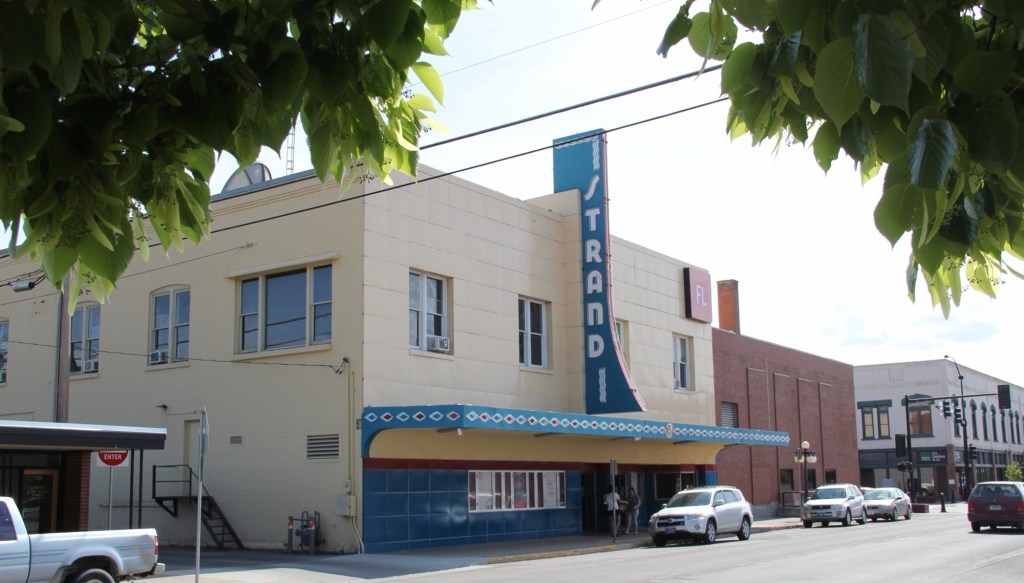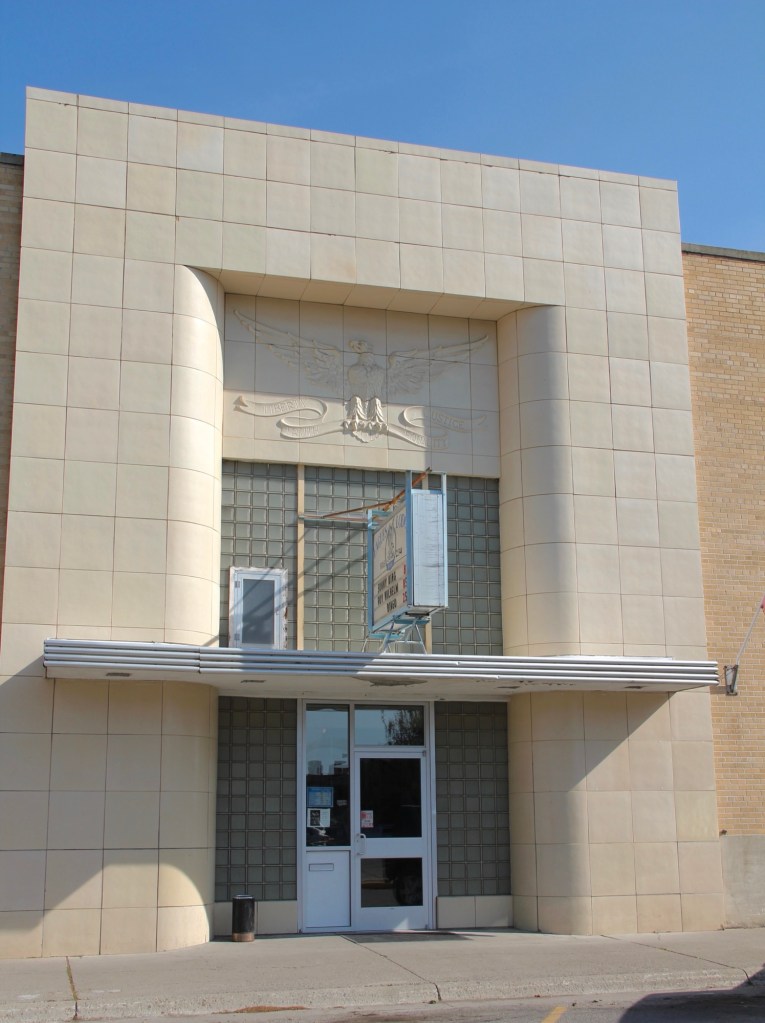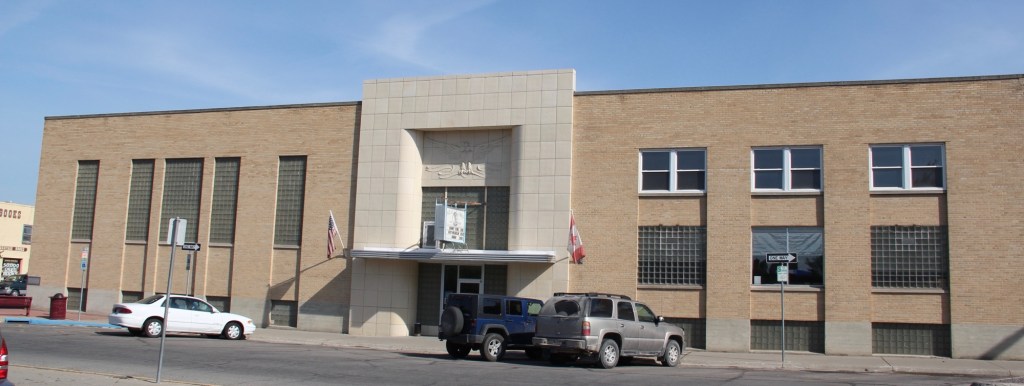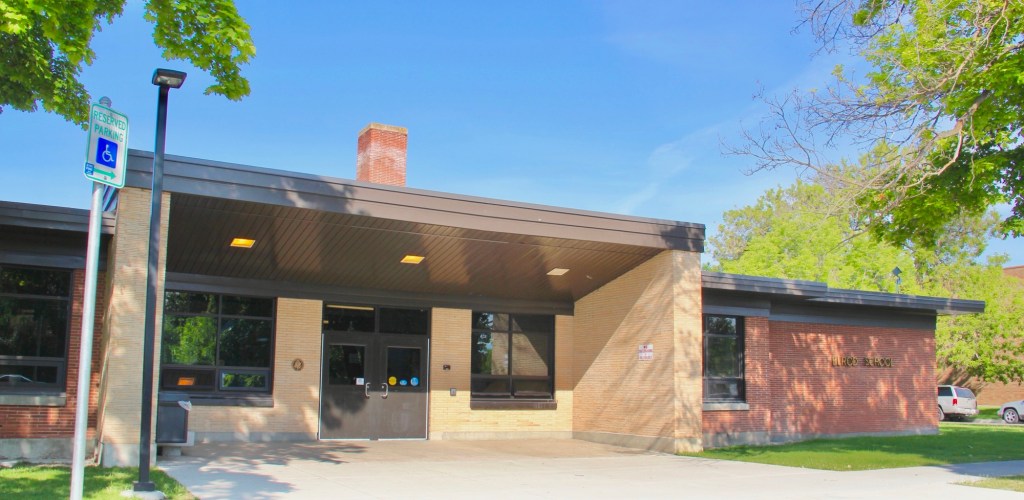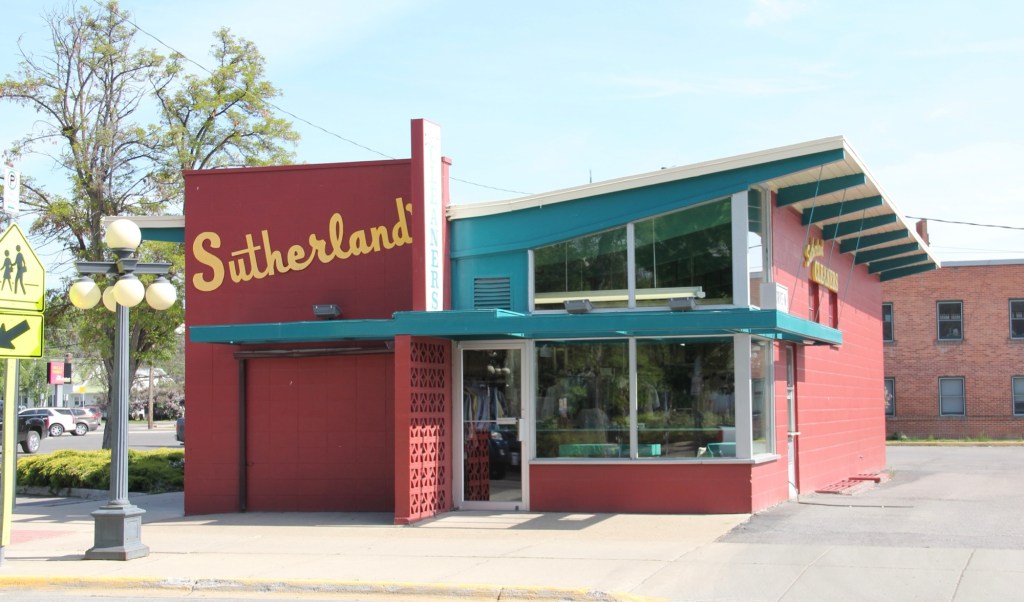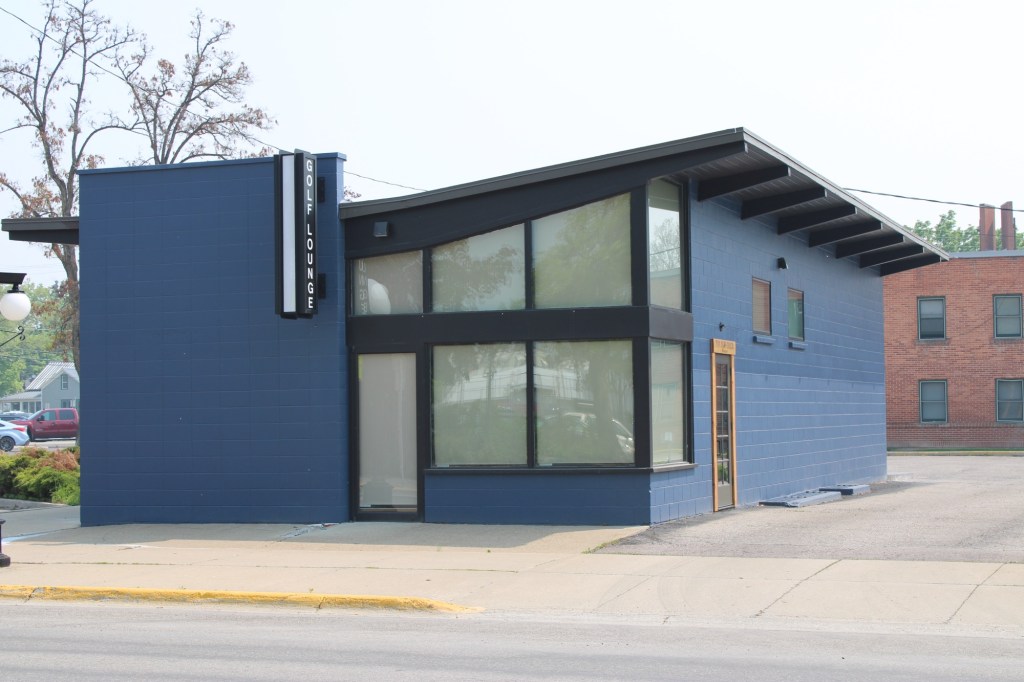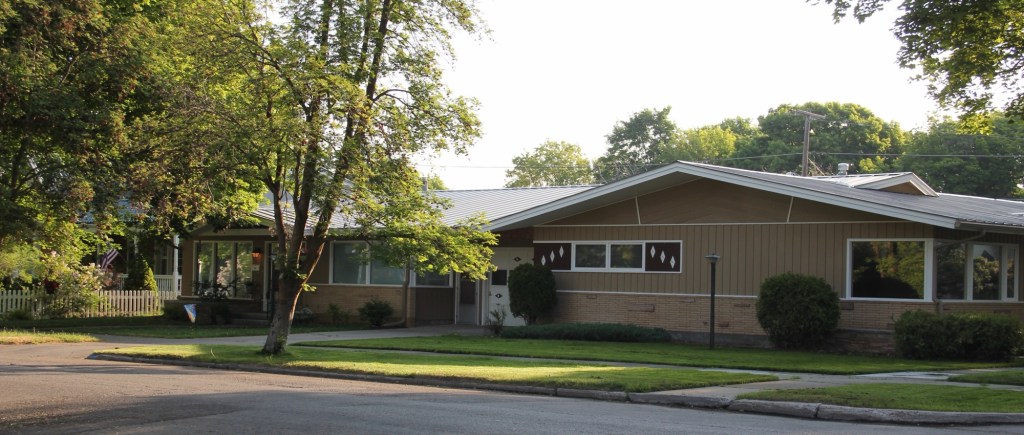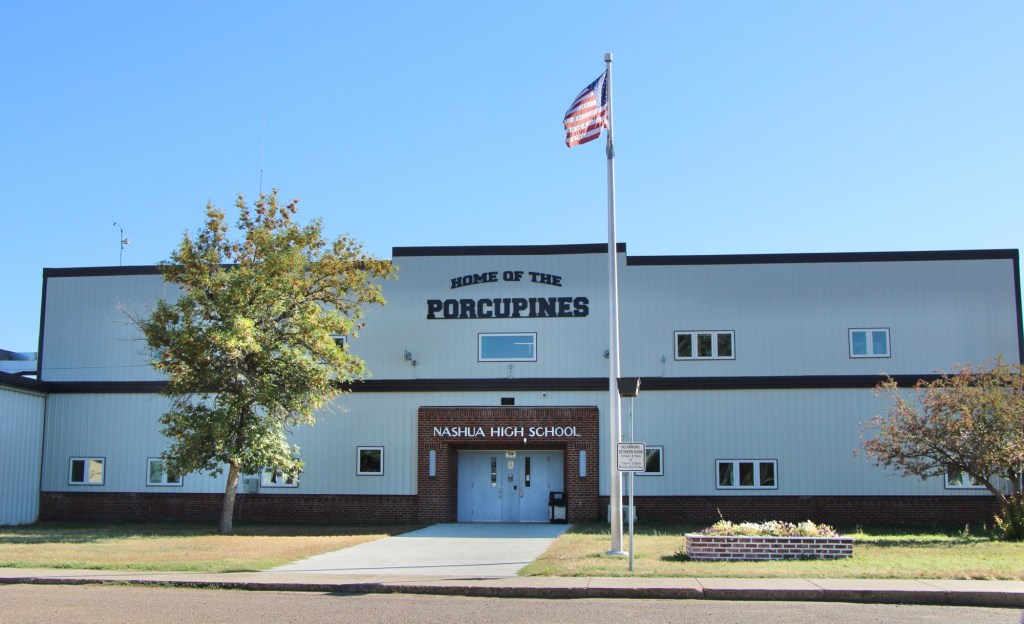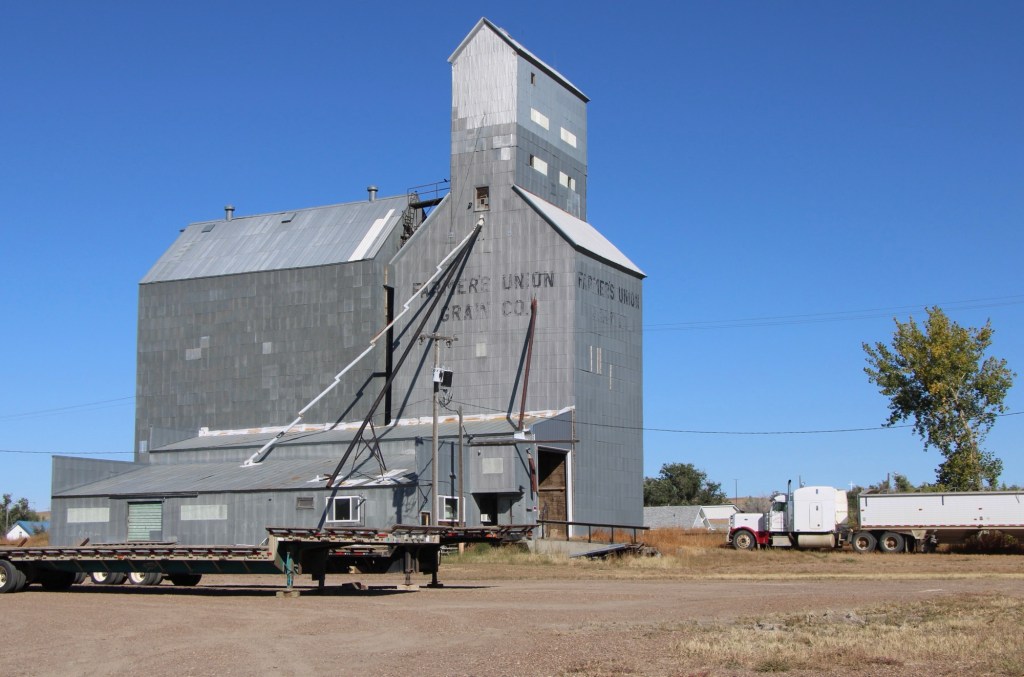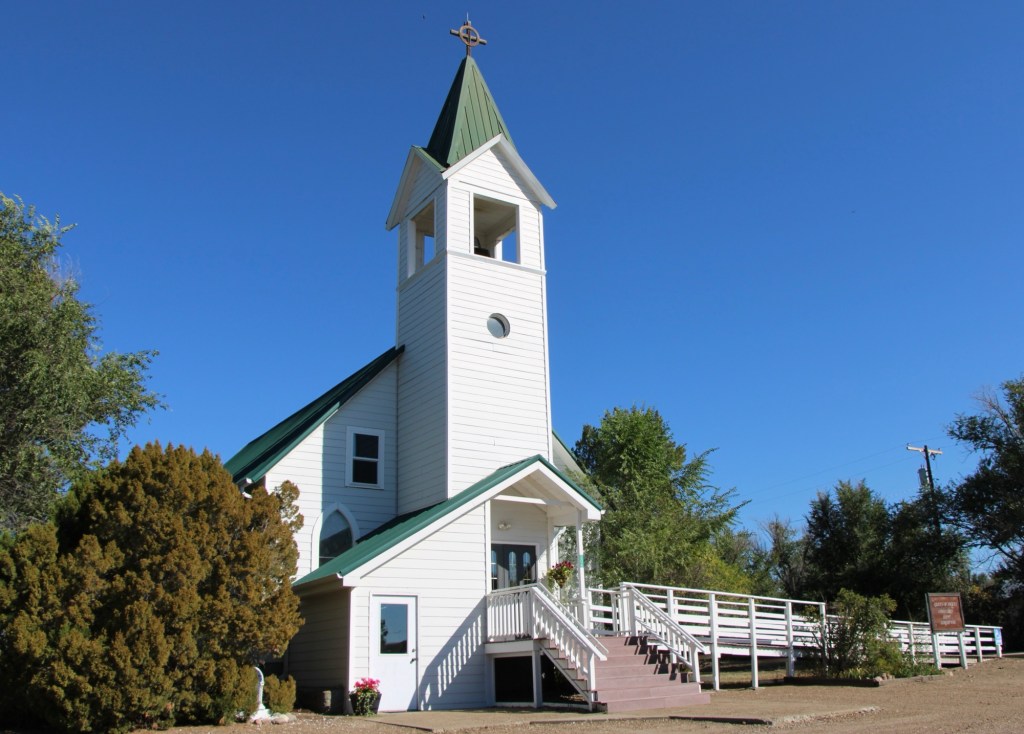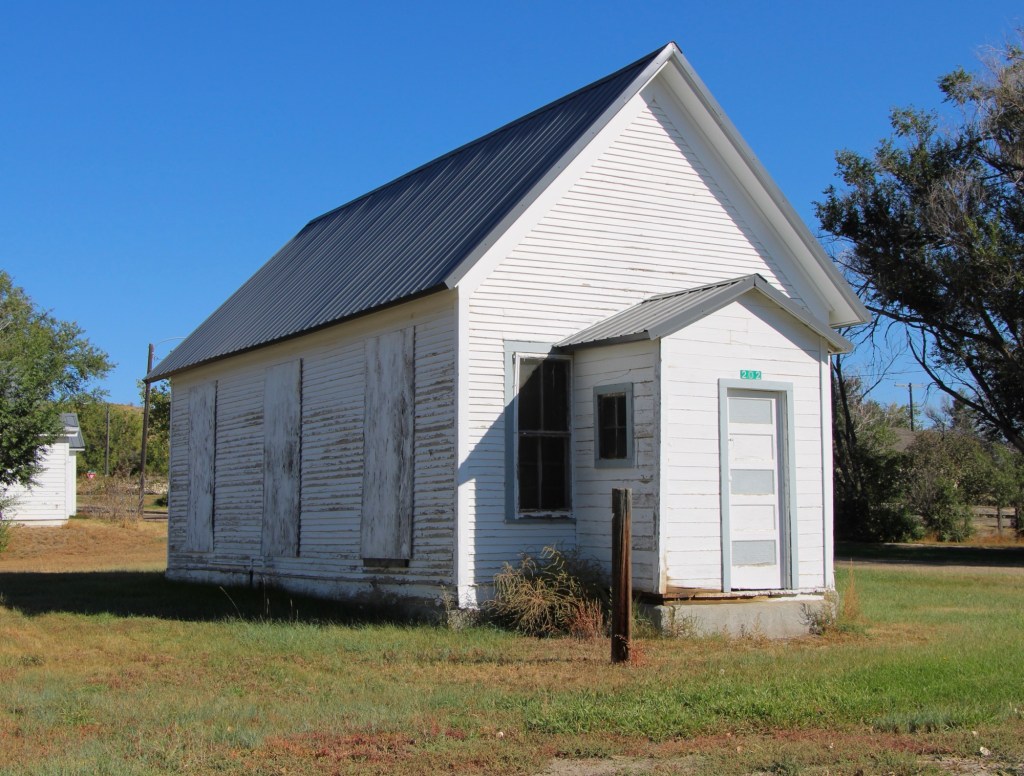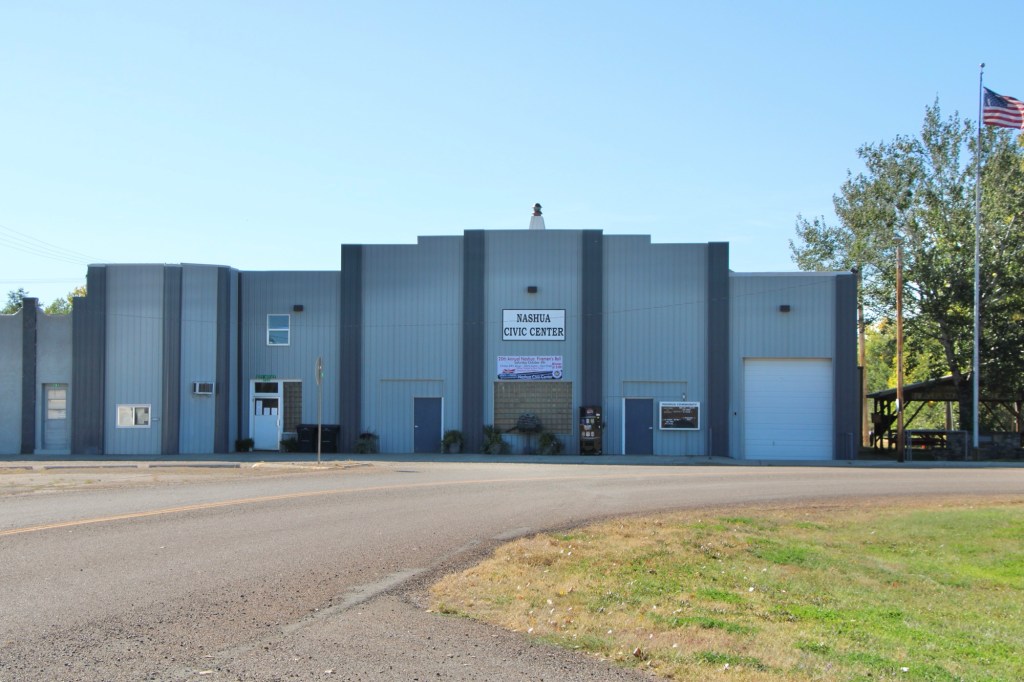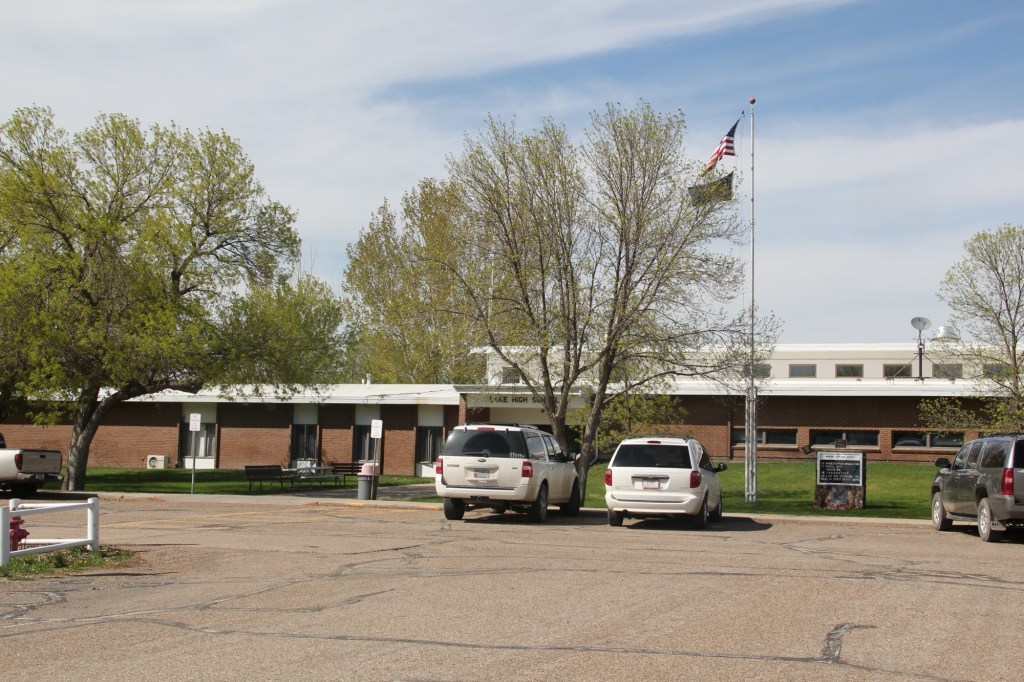
Repeat visitors to this blog about historic places in Montana quickly see that the focus is very much on the era of 1860 to 1960. But I have taken time to also record the modern past. This brief detour into northeast Montana (Roosevelt, Sheridan and Daniels counties) shares commercial, public, and religious buildings from the late 20th and early 21st century.
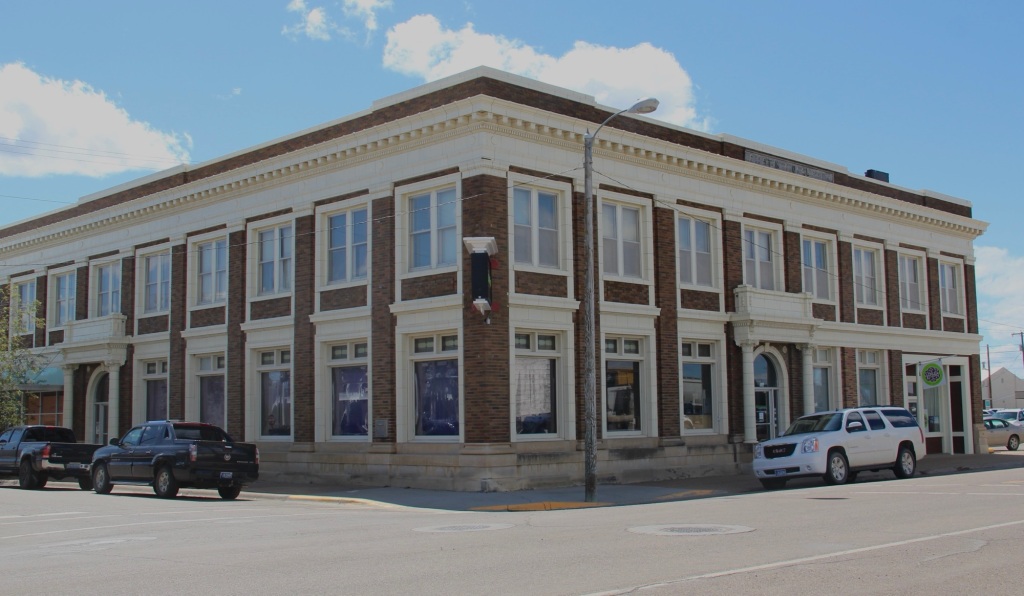
The Montana State Bank (now in 2024 the Bank of Plentywood) in Plentywood has its business roots in earlier bank in the railroad town of Reserve. Its echoing of classical columns in a modern setting makes it my favorite modern style bank in the region.
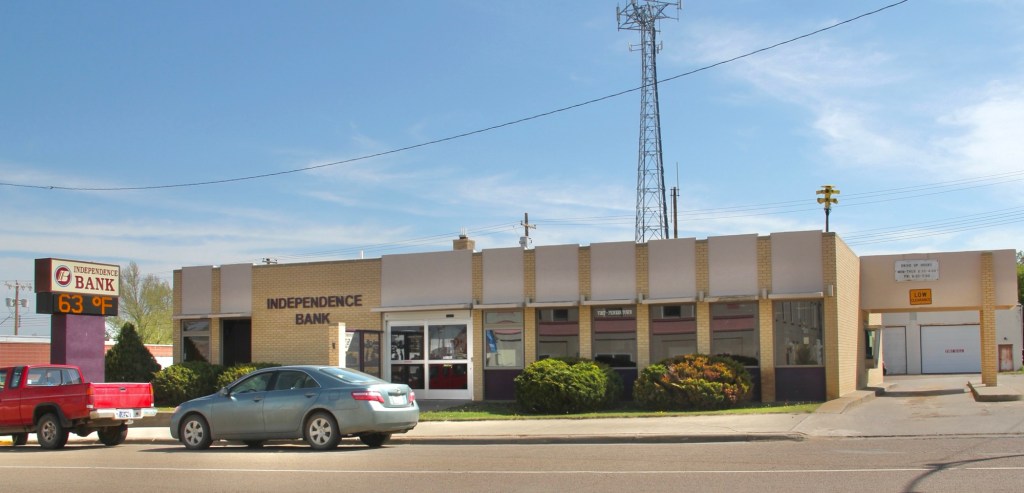
Not far behind is the Independence Bank in Scobey, built in 1972. After the First Security bank of Havre acquired the bank in 1998 it changed the name to Independence in 2000.
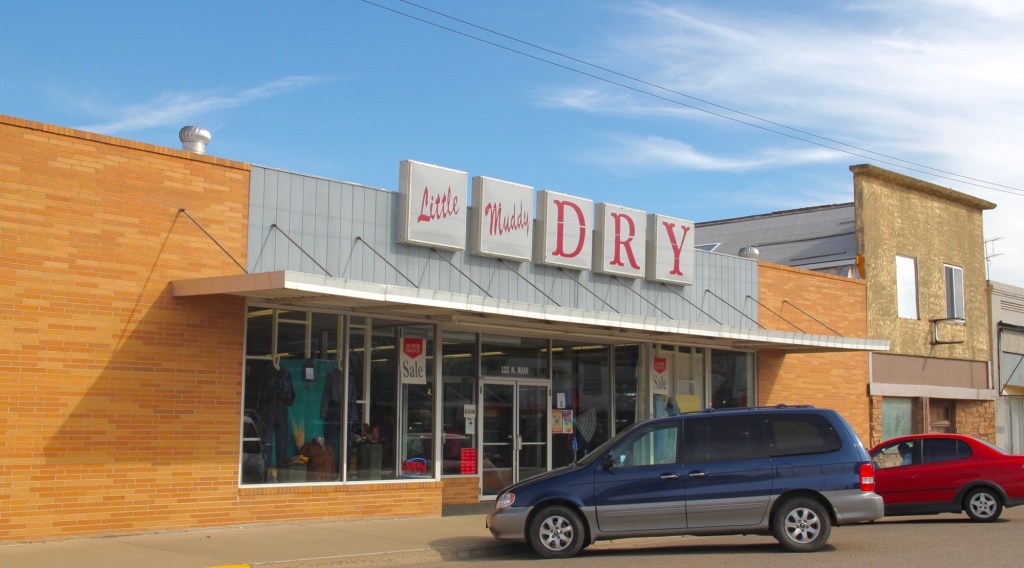
The store is now closed.The store front has changed since this image from 2013
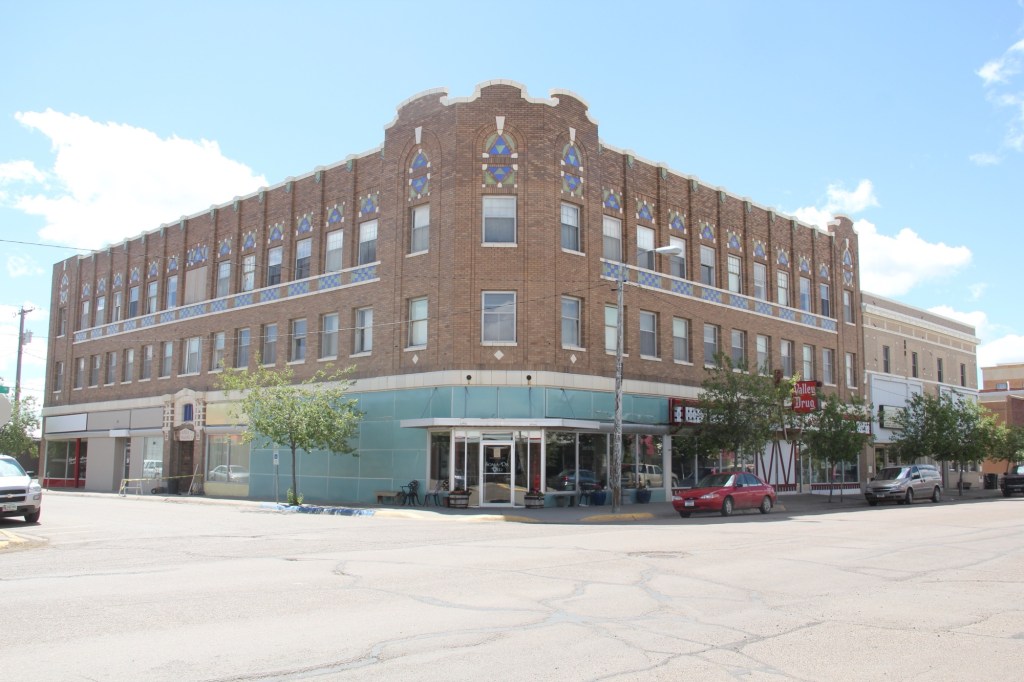
Colorful metal sheathing over old storefronts helped owners update their businesses from the 1960s into the 1980s, enabling downtown locations seem more like shopping centers. The top example is from Plentywood while the bottom, Bryan’s, is from Wolf Point.
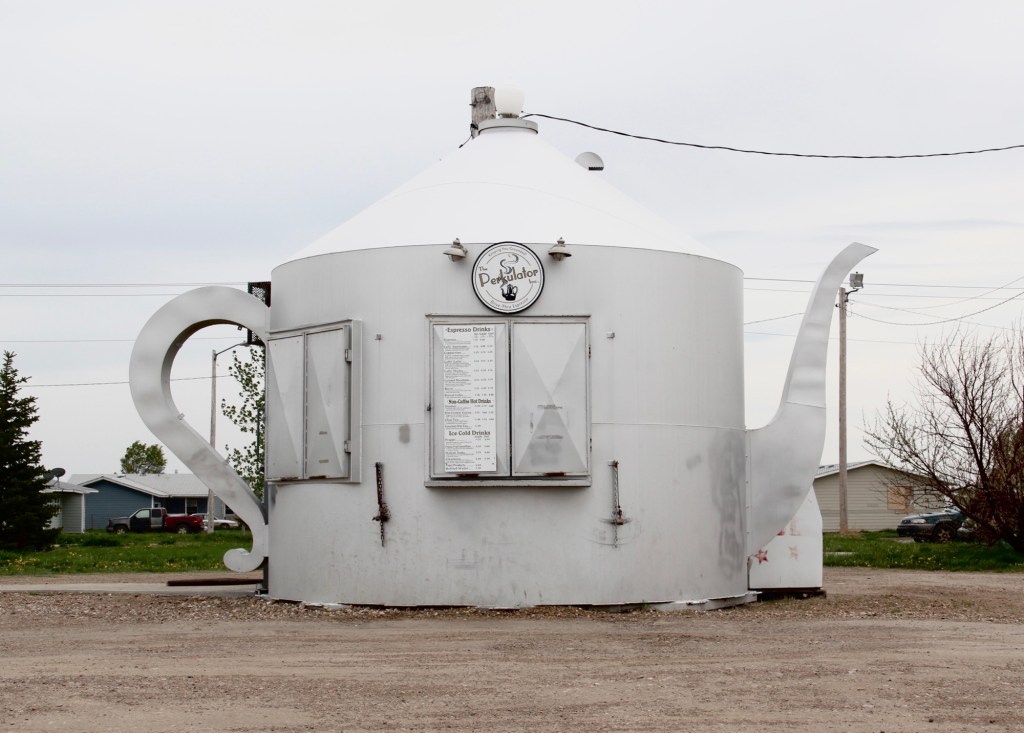
The Perkulator coffee shop is still going strong on U.S. Highway 2 in Poplar. Highly recommended!
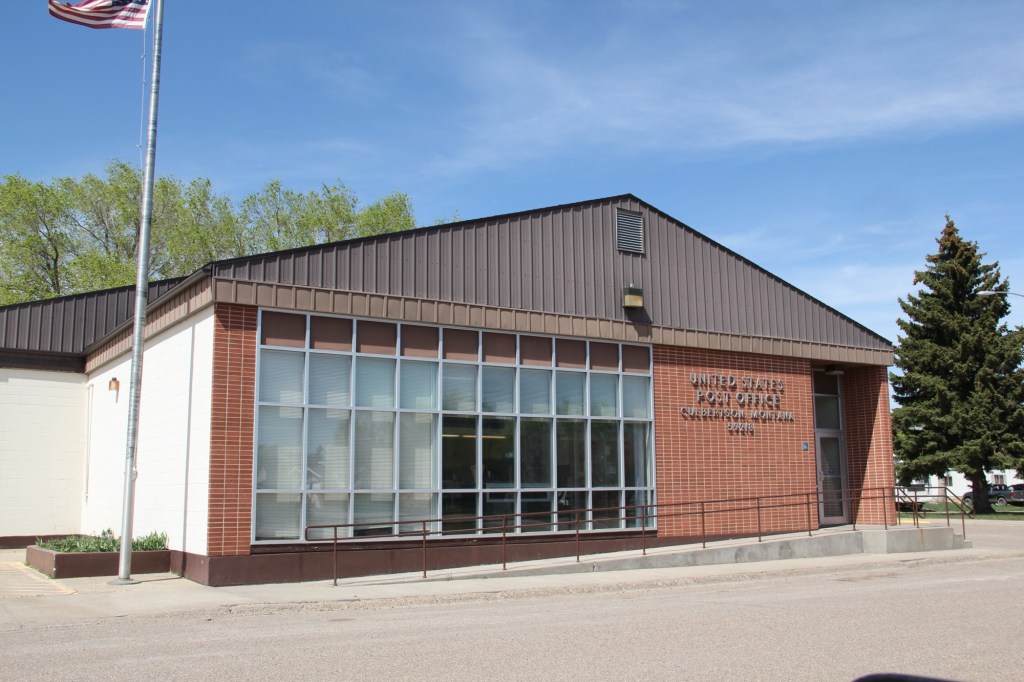
The design of U.S. post offices moved away from the preference for Colonial Revival styles in the first half of the 20th century and embraced a modern look as shown in Culbertson (top) and Scobey (bottom).
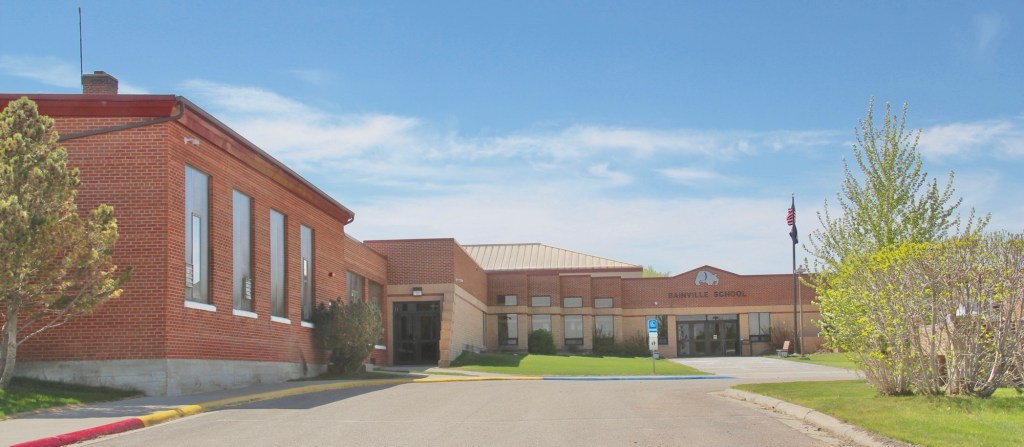
The Roosevelt County office building in Culbertson continued with modem styling into the 21st century. Staying in Roosevelt County new schools for Culbertson and Bainville in the early 21st century also shared contemporary styling. Bainville school
Fort Peck Community College in Poplar has significantly expanded its campus after achieving accreditation in 1991 and the gaining land-grant status in 1994.
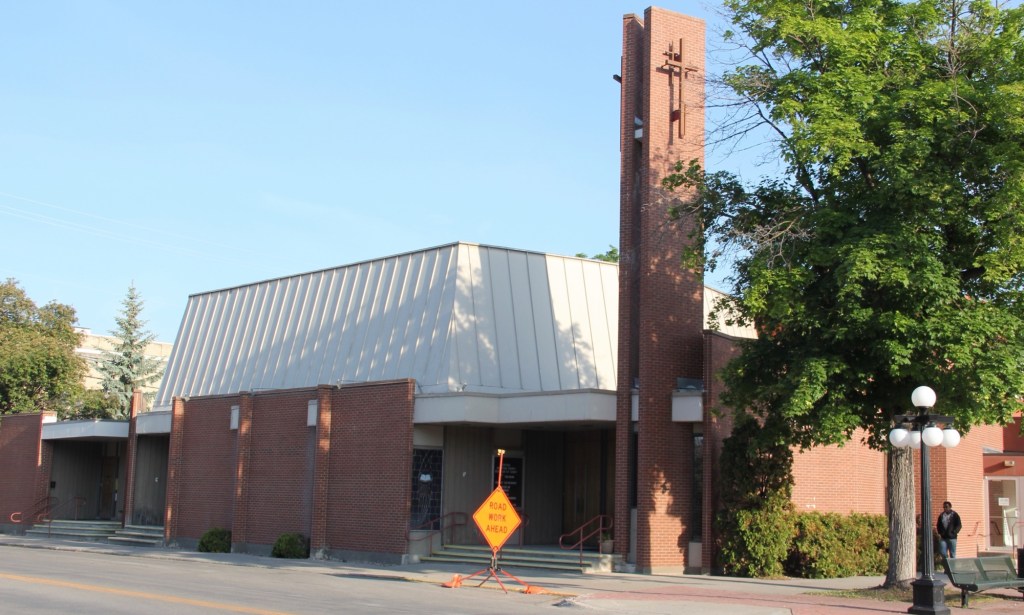
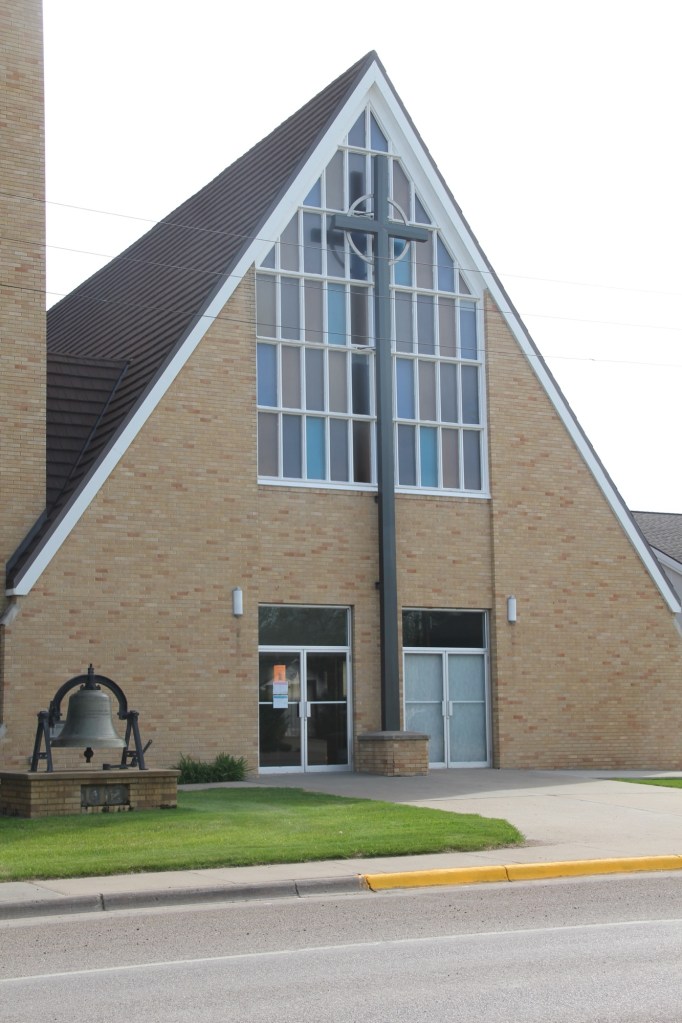
Lutheran churches in Plentywood and Wolf Point are also modern landmarks. Plentywood Lutheran ELCA dates to c. 1957-1960 while the Trinity Lutheran Church is a late 19th century congregation that worships in a 1960s building.
Plentywood Lutheran Plentywood Lutheran ELCATrinity Lutheran in Plentywood Trinity Lutheran in Plentywood
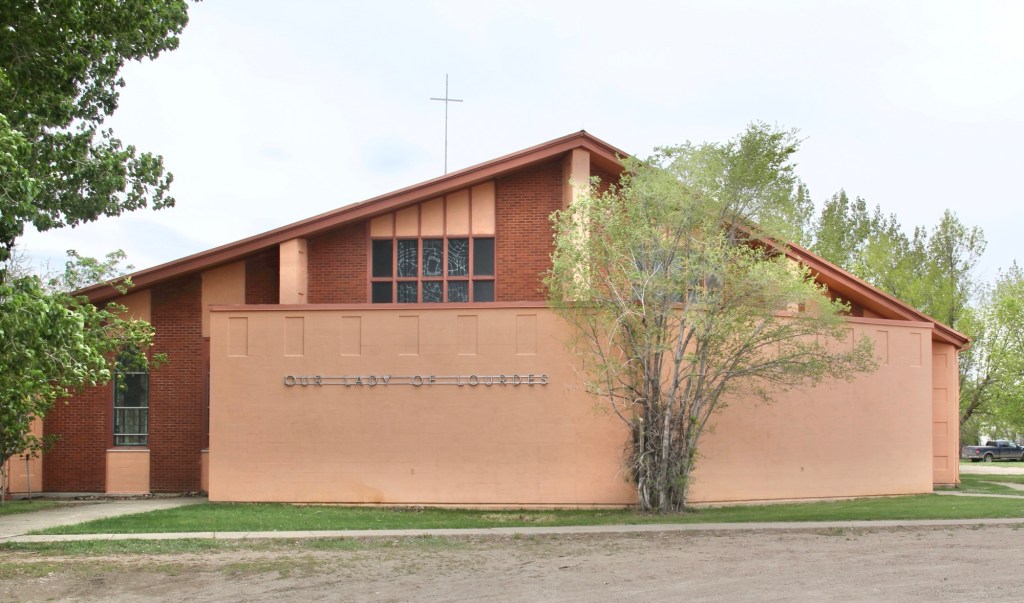
Our Lady of Lourdes Catholic Church, a 19th century congregation, in Wolf point ends our regional tour of Montana modernism. the building reflects the diocesan decision to build contemporary style churches in towns large and small through eastern Montana in the 1950s and 1960s.
Montana Highway 16 stretches north from U.S. Highway 2 following a spur line of the Great Northern Railway laid about 1910. Following that railroad corridor first brought me to Medicine Lake, the actual lake and town of that name in February 1984.
Great Northern depot in 1984
When I returned over thirty years later, the depot was gone, but the lake and town were doing ok.
Depot is gone today
Medicine Lake is a very important place in northeast Montana and the 8,000 + acre lake has been protected as a National Wildlife Refuge since 1935.
Medicine Lake NWRMedicine Lake NWR
Native Americans for centuries visited and hunted here, as hundreds of tipi rings along the lake bluffs documented. The lake remains a touchstone for several tribes today.
Medicine Lake, MT
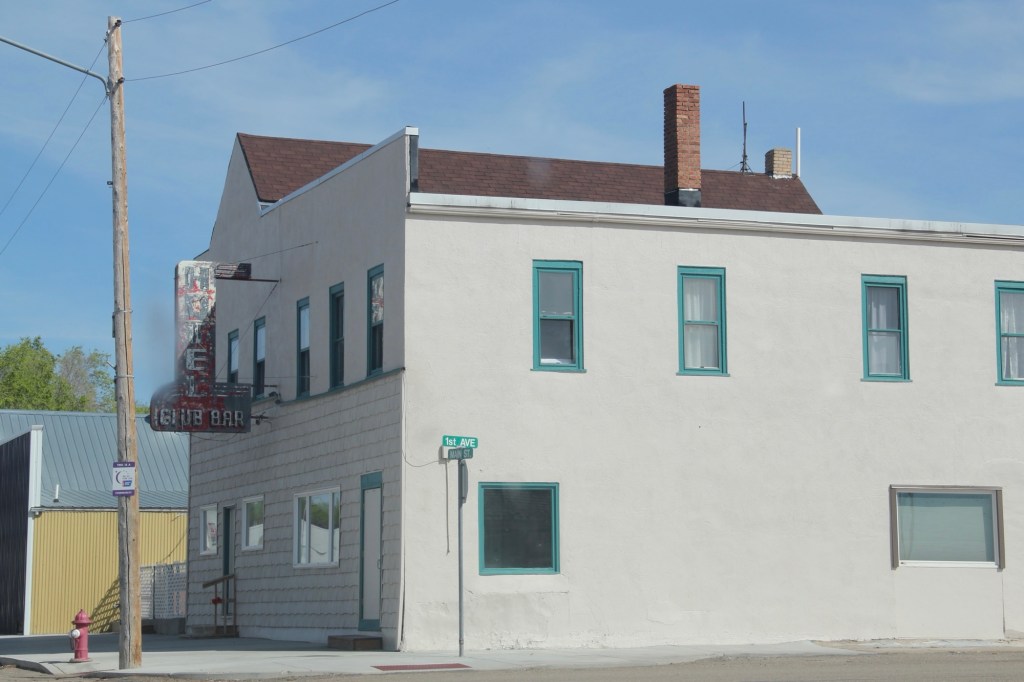
The town is much more recent, established by the railroad in 1910, with the iconic Club Hotel and Bar in business within a year.
I have stopped at the Club Bar where the old neon sign was a bit weathered but hospitality was everywhere. Don’t know about the hotel—maybe rooms was still used during the hunting season.
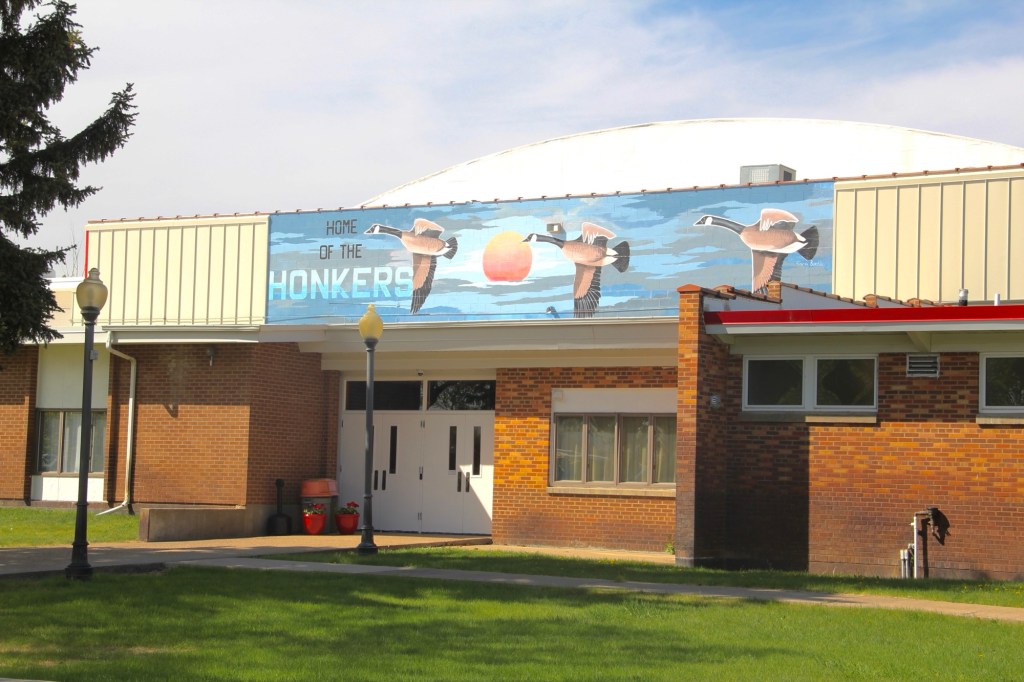
The Medicine Lake K-12 school keeps the town of about 250 people together but since my last visit the school lost its distinctive mascot name of The Honkers. For sports the school has merged with Froid and took us nickname of Red-Hawks. Did that mean that town gathering spot would change its name from the Honker Pit? Absolutely not. Great place!
Medicine Lake, the town, has several buildings from its first generation of settlement, including a corner gas station (adapted into a new business) and classic false-front one-story commercial buildings, including a lumber business and a hardware store.
Yet a dwindling population has hurt the business core. For 40 years between 1940 and 1980 the town’s population stayed around 400. The next 40 years witnessed a decline—and in a small town a loss of 150 people can really hurt.
But the town began a slight rebound in population in between 2010 and 2020, with some of it fueled by fracking man-camps
The bones of an early 20th century homestead town are still there. I hope to visit again and see new changes in 2025.
In 2024 I began to see media accounts, both regionally and nationally, of how Glasgow, the seat of Valley County, was the most isolated place you can imagine, truly in the Middle of nowhere.
Historic Great Northern Railroad corridor in Glasgow
I’m not one to argue with geographers and economists. I’m sure from their perspective, they got it right. But I never thought of Glasgow as isolated: it is on the Great Northern mainline, and part of the famed Empire Builder Amtrak route, and on U.S. Highway 2.
Great Northern depot, Glasgow
Then the town has always shown a great deal of pride and ambition, conveyed so effectively by its many historic buildings, starting with the First National Bank, built c. 1884 and listed in the National Register of Historic Places.
1st National Bank building, Glasgow
When you enter the town from the underpass of the railroad, the bank is the first landmark to catch your eye, appropriate too for the impact of local banks on a town’s economic prospects during the homesteading boom and bust of the 1910s and 1920s, respectively.
Rundle Hotel, during renovation in 2013
Another landmark from the homesteading era is the Rundle Building, once the Glasgow Hotel and restored in the last ten years as an upscale hotel in the heart of downtown. Built c. 1916 and designed by the important Billings firm of Link and Haire, the Rundle is a captivating statement of an Arts and Crafts-infused Mediterranean Revival style. I have been trying to get back to Glasgow to stay here for the last four years—maybe I will make it in 2025.
The 1930s transformed Valley County through the construction of the mammoth Fort Peck Dam on the Missouri River. Glasgow too has a major New Deal landmark in its U.S. post office and courthouse, built c. 1939 and designed by federal architect Louis A. Simon.
Post office/federal courthouse, Glasgow
Its understated New Deal Deco exterior obscures a jewel of an interior, highlighted by its New Deal-funded 1942 mural depicting local history and the changes brought about by the Fort Peck Dam by artist Forest Hill. This building too is listed in the National Register.
Glasgow post office mural
Another important New Deal supported building was all about the community, and providing new opportunities: the Glasgow Civic Center. It too has a New Deal Deco style, and its large public space has been used for almost every type of event or gathering you can imagine.
Glasgow Civic Center
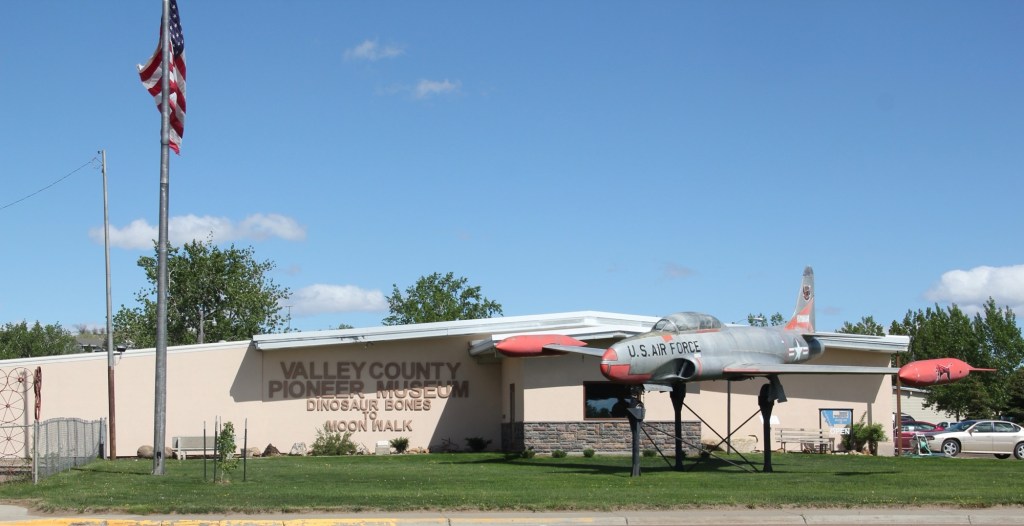
Glasgow’s sense of itself today still respects it past, brilliantly conveyed by its large and expansive museum. When I first visited Glasgow 40 years
Valley County Museum
ago, I held a public meeting on the state historic preservation plan here, and the next morning residents gave me a detailed tour of the recently established museum. I was impressed with its collection then, now it sprawls through the building to the adjoining grounds.
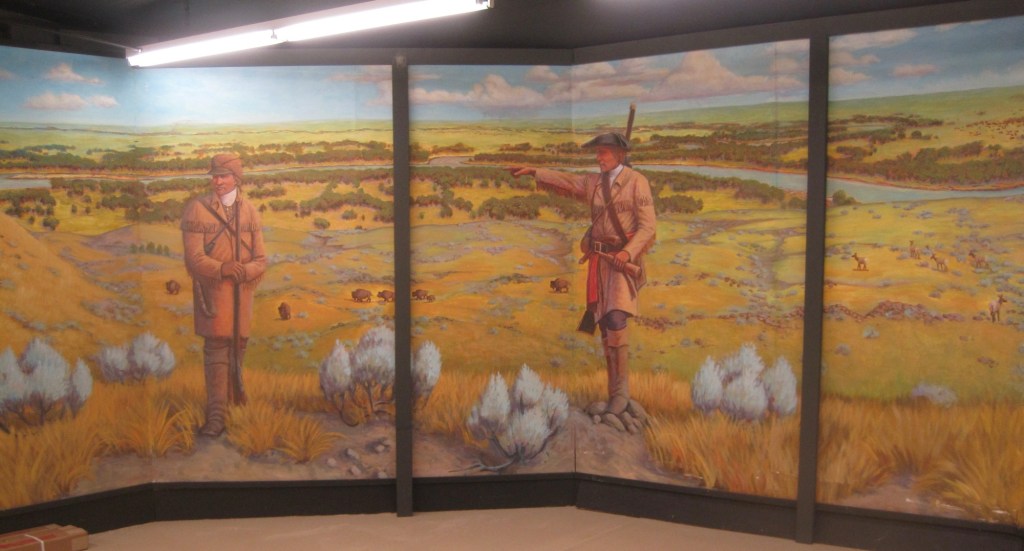
Veterans section of the museumThe high school band sectionLewis and Clark mural, 2095, by Jessie Henderson, a Chippewa/Cree artistThe back bar at saloon exhibit
Indeed, the saloon exhibit underscores another fun part of Glasgow—across from the depot in the original route of Highway 2 is an amazing collection of bars, stores, and eateries, right out of the early 1900s.
Glasgow bars at depot
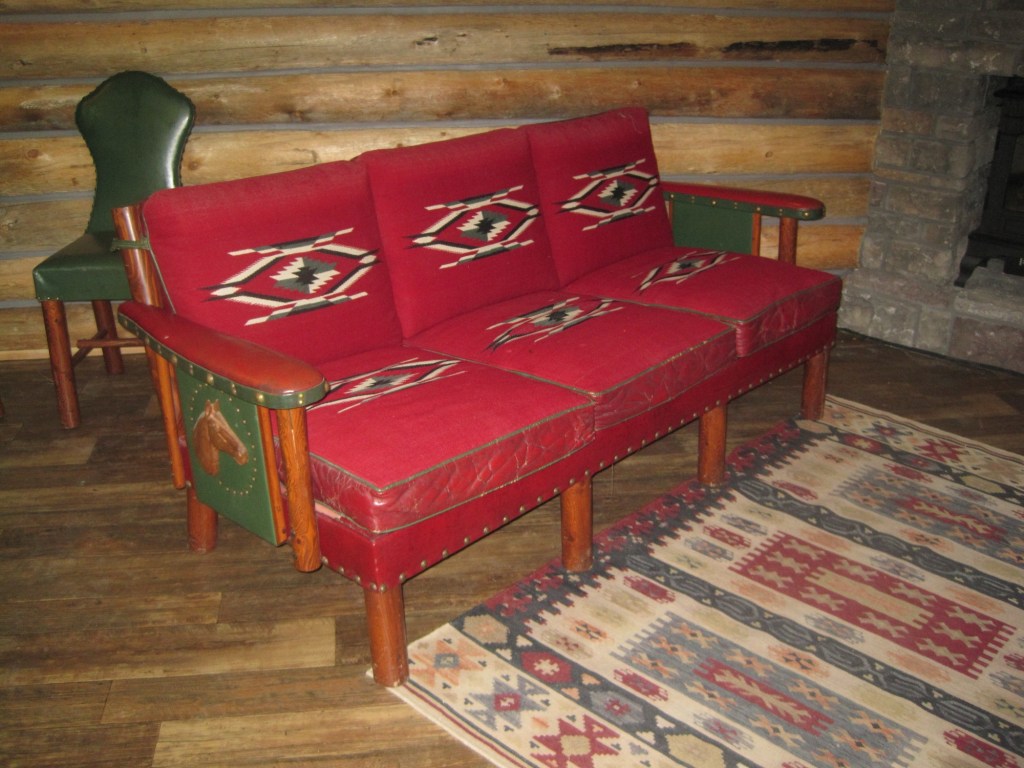
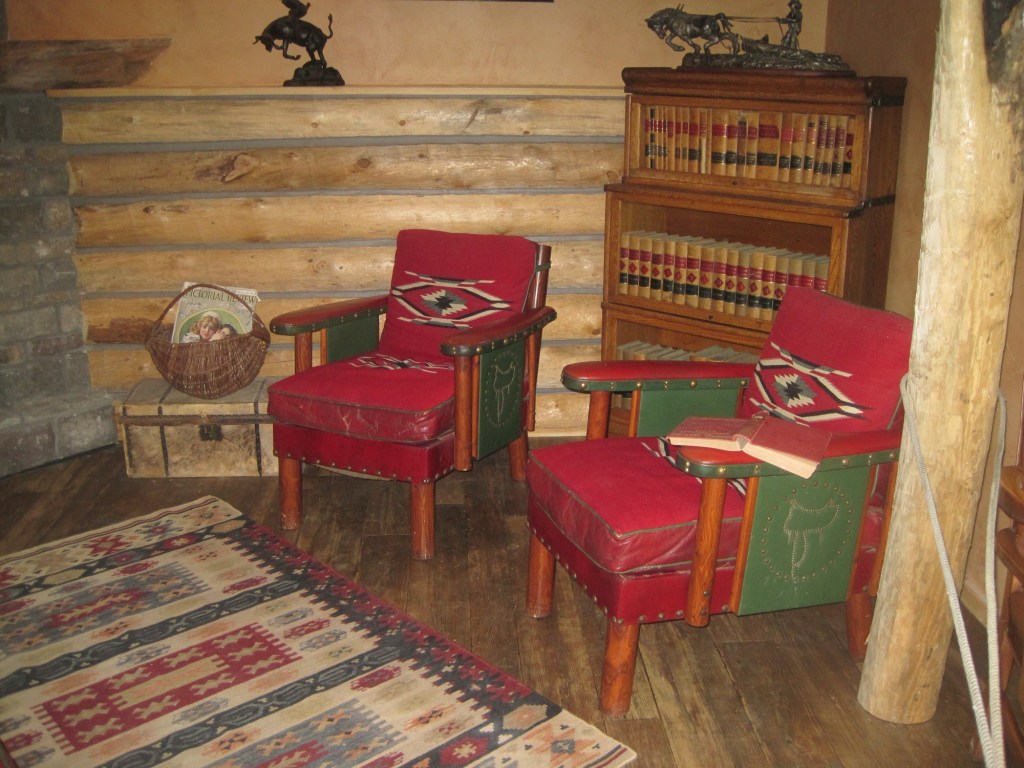
But back to the museum, and its important Montana decorative arts collection of the work of modern craftsman Thomas Molesworth, once in the town’s Carnegie library.
The newer exterior exhibits led the museum to move entire building to the property, including examples of the homestead shacks of the early 1900s that were followed by permanent homes such as this white painted bungalow.
Representative ranch house from homesteading boom
Pride of place, pride of the past. Glasgow might be in the middle but it is far from being nowhere as this small sampling of properties demonstrates.
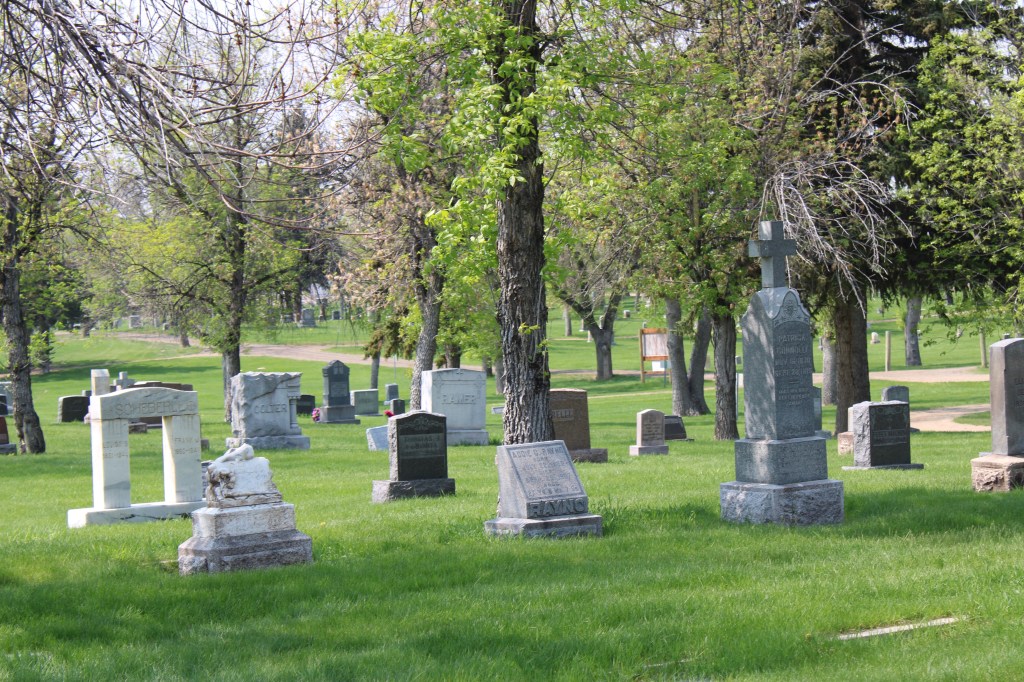
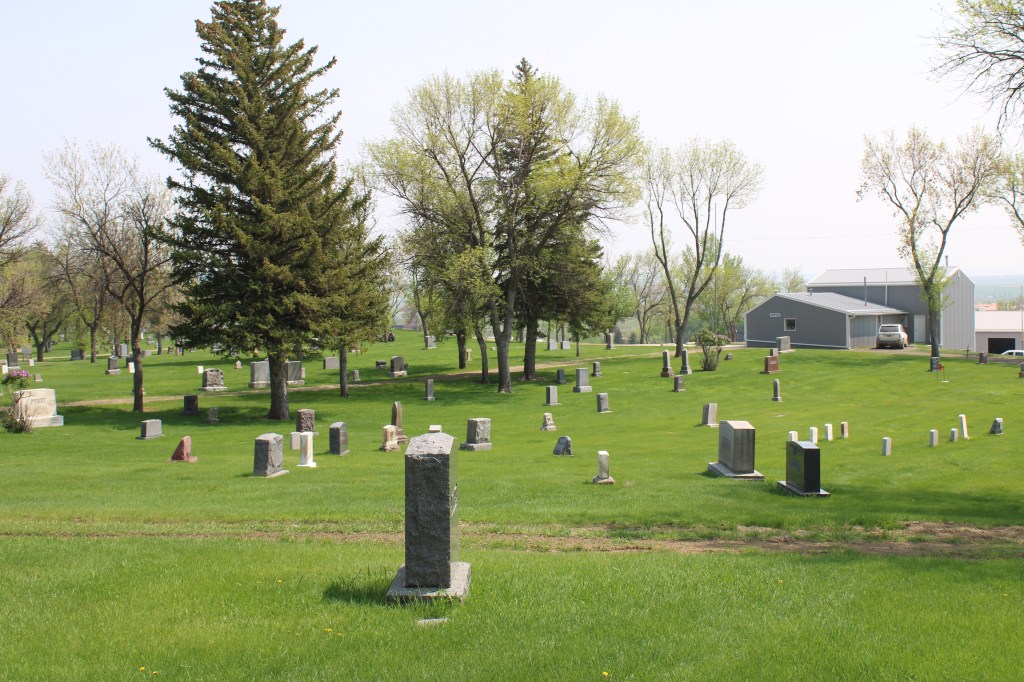
Nestled in the bluffs overlooking Havre are two adjacent historic cemeteries, Calvary (1903) and Highland (1906/7).
Entrance gate, Highland Cemetery
Catholics in north central Montana established Calvary first, taking advantage of newly located city water works to ensure that the grounds could be irrigated.
Looking north toward the Calvary Cemetery entrance. Note water works in upper right corner.
Calvary with its well manicured lawns, large mature trees, curvilinear drives and impressive view to the south set the tone for the landscaping and design of both cemeteries. Grave markers, for the most part, were modest, in keeping with the working middle class character of this Great Northern Railway division point.
Of course there were exceptions to the norm. A large Cross marks the gravesite of Judge Patrick McIntyre, one of the city’s early civic and real estate leaders who died in 1907. The classical styled marker to another of the city’s, and region’s, business leaders, Samuel Pepin, is nearby. Pepin, like McIntyre, was a Canadian who came early to Havre and developed businesses and ranches, all tied to the Railroad. Pepin died in 1914.
McIntyre markerSamuel Pepin marker
Highland Cemetery followed in the footsteps of thee catholic burial ground. Both have impressive views along the southern boundaries of the historic campus of Northern Montana University, now MSU-Northern (name change happened in 1994). The campus was established in 1929.
MSU-NorthernA panoramic view
By that year, Highland Cemetery was well established as the city’s primary public burial ground,and is still active today. Reflecting Havre’s middle class roots the cemetery is marked by rows of modest, dignified tombstones and low concrete walled family plots.
Many veterans from the 20th century are buried here, along with many tombstones marking membership in fraternal organizations from the Woodmen of the World to the Masons.
Highland Cemetery is a significant place that documents the city’s progressive response to public needs during its decade of sustained growth in the homesteading boom of the first two decades of the 20th century. Together the two cemeteries would be an excellent companion to Havre’s already established National Register-listed downtown residential district. The city does a fine job of keeping the property maintained and let’s hope that commitment stays in place for another 100 years.
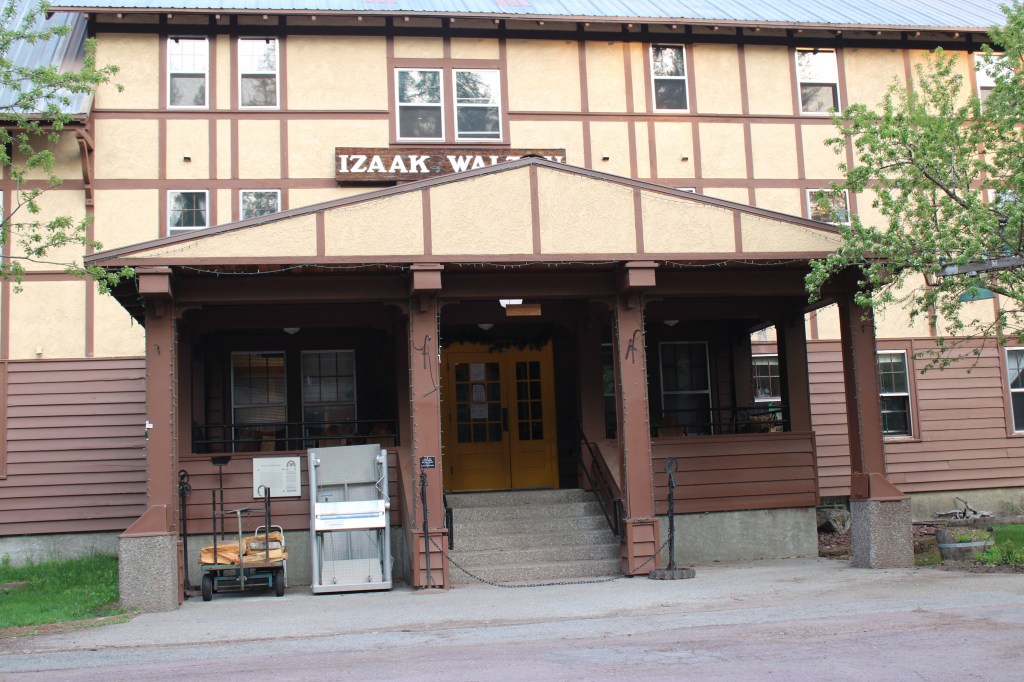
The news came like a thunderbolt in the December 16, 2022 edition of the Montana Free press: the Izaak Walton Inn had been sold to LOGE Camps.
“Street” facade of the building
I must admit that the place is special to me because it was one of the first National Register of Historic Places nominations that I had ever worked on. As I have discussed earlier in this blog, my task was to document its extraordinary significance because at that time of nomination (1984) the building was not yet 50 years old.
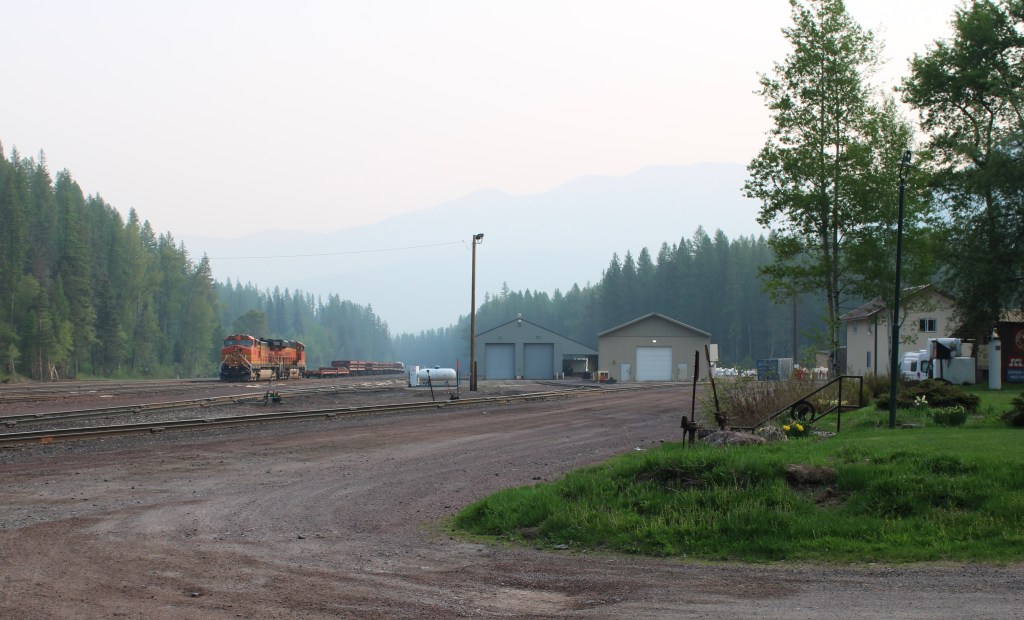
Historic Great Northern yards next to the inn, May 2023
Making the case was not that difficult because when it was built in 1939, it basically WAS the village of Essex: lodging for railroad workers, food, bar, post office, etc., but I have covered these points earlier in the blog. I stopped in May 2023 to document the place one last time, before n auction of interior stuff and collections and before renovations began.
In that December 16, 2022 Montana Free Press story, LOGE Camps official Slate “Olson said LOGE was well aware of the inn’s history and is not planning drastic changes to the property. However, the company does plan to make upgrades. Olson said it’ was’s too early to know exactly what those improvements will be, but that new furniture and room amenities are likely on deck in the coming year. We have a ton of respect for the history of the Izaak Walton Inn,” he said. “We want to create a destination where you feel the history, but you also appreciate the updated touches and amenities.””
May 2023May 2023
Let’s hope so. A good part of the historic integrity of the property lies with its rough edges. The old boarding houses was upgraded to a degree in the mid-1980s, certainly. But you also had the right spaces, the post office boxes, and the laid back vibe of common areas. And wi-fi: well good luck once you left the link in the lobby.
May 2023May 2023May 2023
Believe me, I get it. Historic places are always changing. But here at Essex you have to accept that the building was a key part of a working landscape of the railroad. That its history will forever be tied to the tracks and the people who worked here. Take away that gritty reality, and you lose so much.
May 2023May 2023This covered pedestrian walkway led to other cabins and trails into the park. It was a great way to see the inn and the railway working together.
Here’s to the first 38 years of the Izaak Walton Inn as a National Register landmark adjacent to Glacier National Park. Let’s hope the next generations recognize and nurture the qualities that make it special.
Standard histories tell you that Cut Bank, the seat of Glacier County, dates to 1891. But significant numbers of permanent settlers did not arrive until the first years of the 20th century, following a major investment by the Great Northern Railroad to build a huge steel bridge and railroad offices, shops, and a roundhouse. The Fort Benton River Press on February 12, 1901, reported that “Cut Bank is rapidly assuming a metropolitan appearance.”
The initial railroad boom soon slowed until the homesteader movement brought new growth. In 1911 town officials agreed to discuss the creation of a permanent town cemetery with state officials. Between 1911 and 1914 citizens formed the Crown Hill Cemetery Association and the first documented burials in the local newspaper took place in 1914.
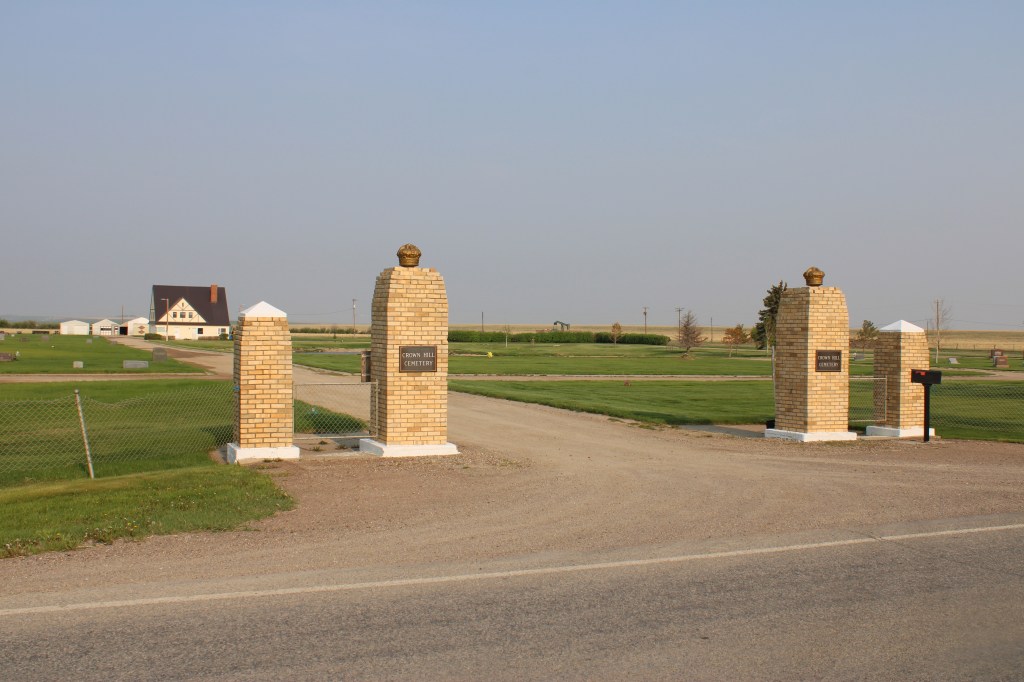
Entrance to Crown Hill Cemetery
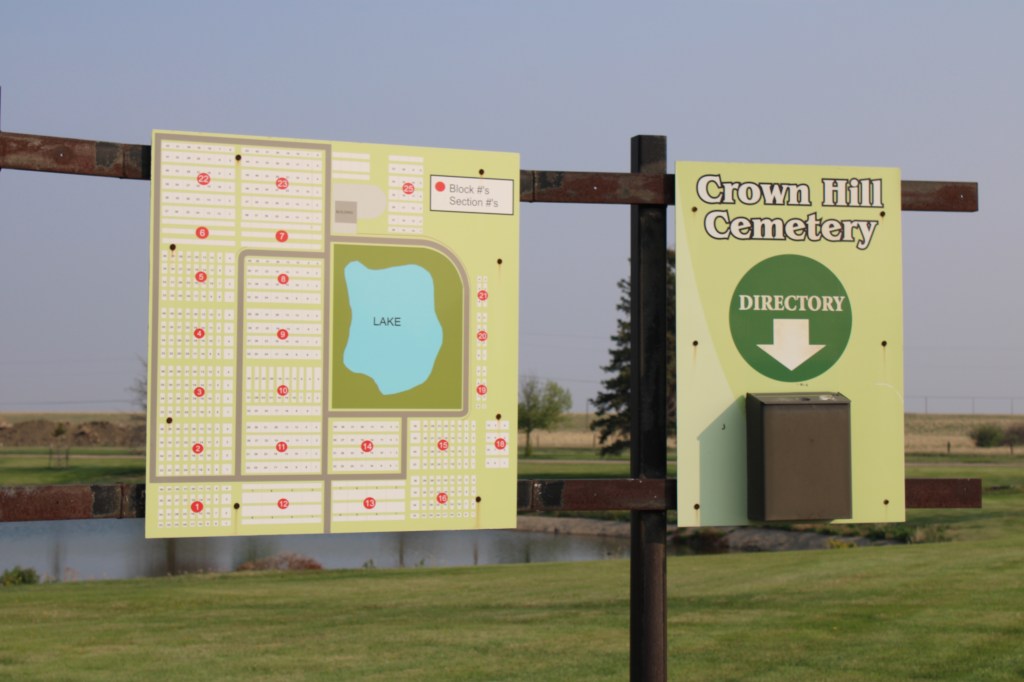
Located north of town the cemetery is on a slight rise and has an impressive view of Cut Bank to the South. A small lake is the focus of the cemetery plan.
See the grain elevators to the south.
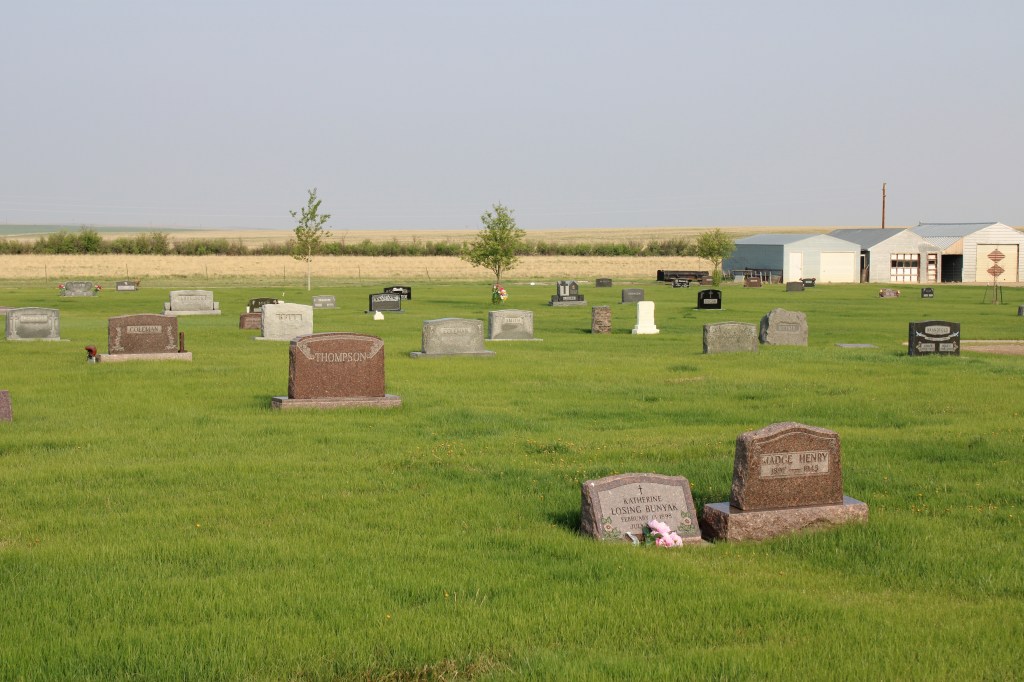
Otherwise the cemetery contains long rows in a rectangular manner and there are few huge grave markers, instead many dignified and subtly designed markers cover the grounds.
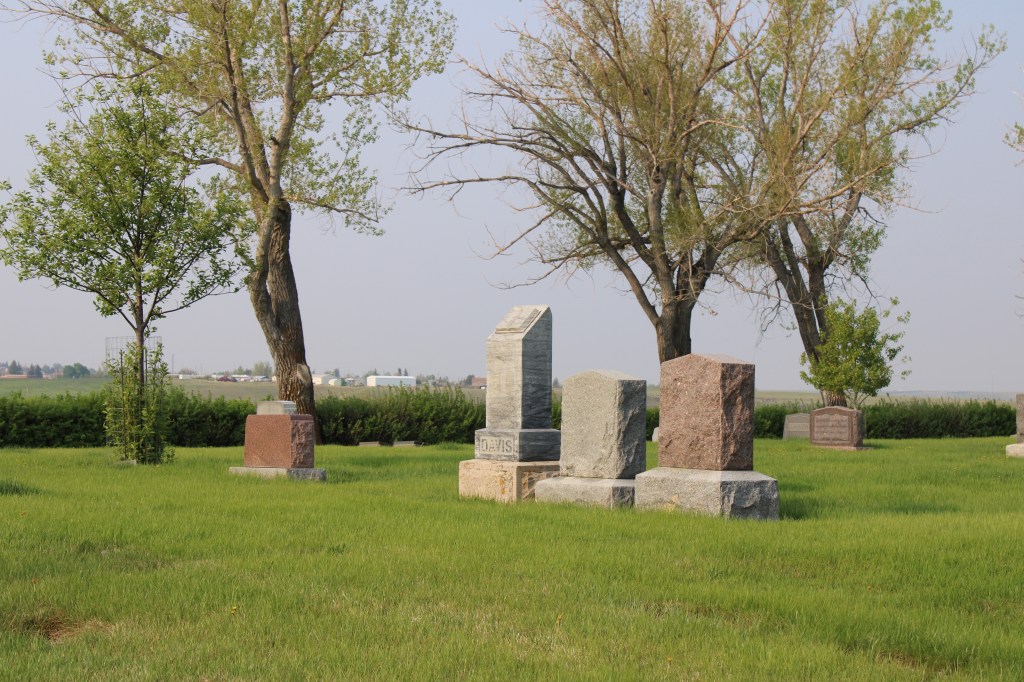
There are several interesting markers and many note a fraternal lodge association.
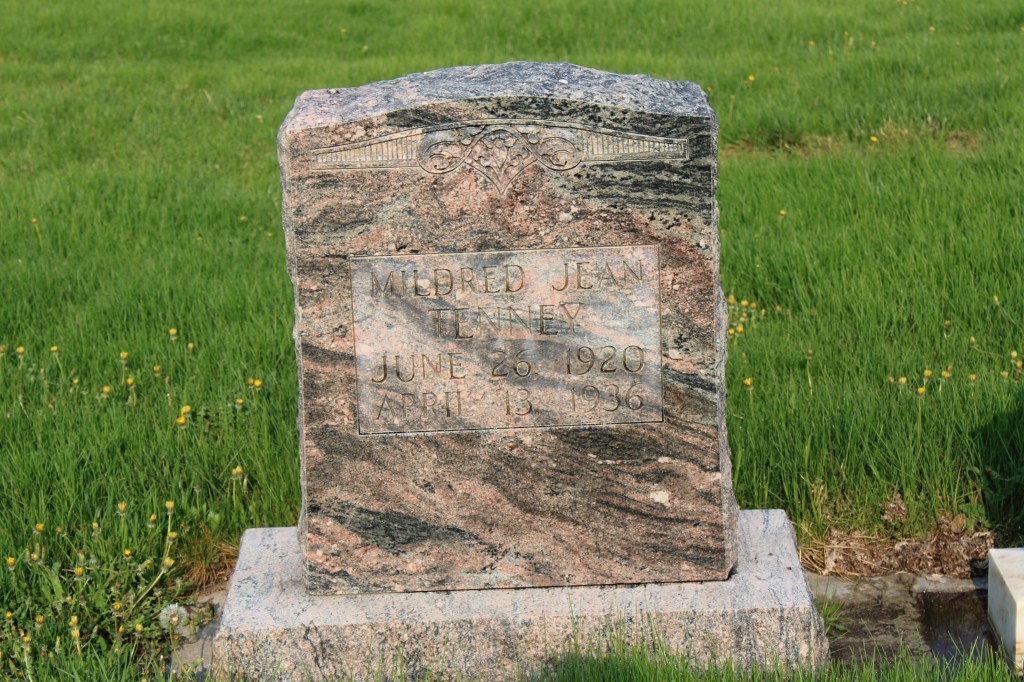
The Thomas marker is one of the oldest.1936 marker with Art Deco styling
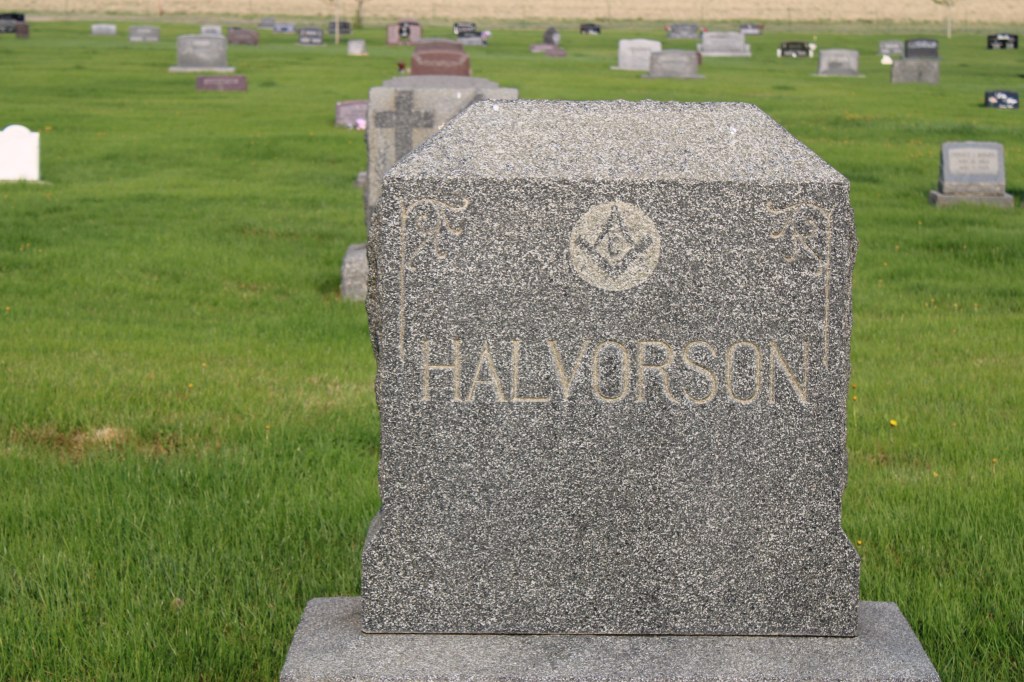
The Halvorson marker dates to be death of Mrs. Harry Halvorson who died in 1924. At that time her funeral was the largest ever held in Cut Bank. The Midland Empire of April 22, 1924 reported that 650 attended the funeral and that 77 cars went from the town Masonic Hall to the cemetery. A member of the Rebekah lodges in both Cut Bank and Shelby, Halvorson’s funeral attracted other lodge members from Shelby, Conrad, Valier and Browning. Her husband was the senior member of the Halvorson mercantile company, which started in 1901.
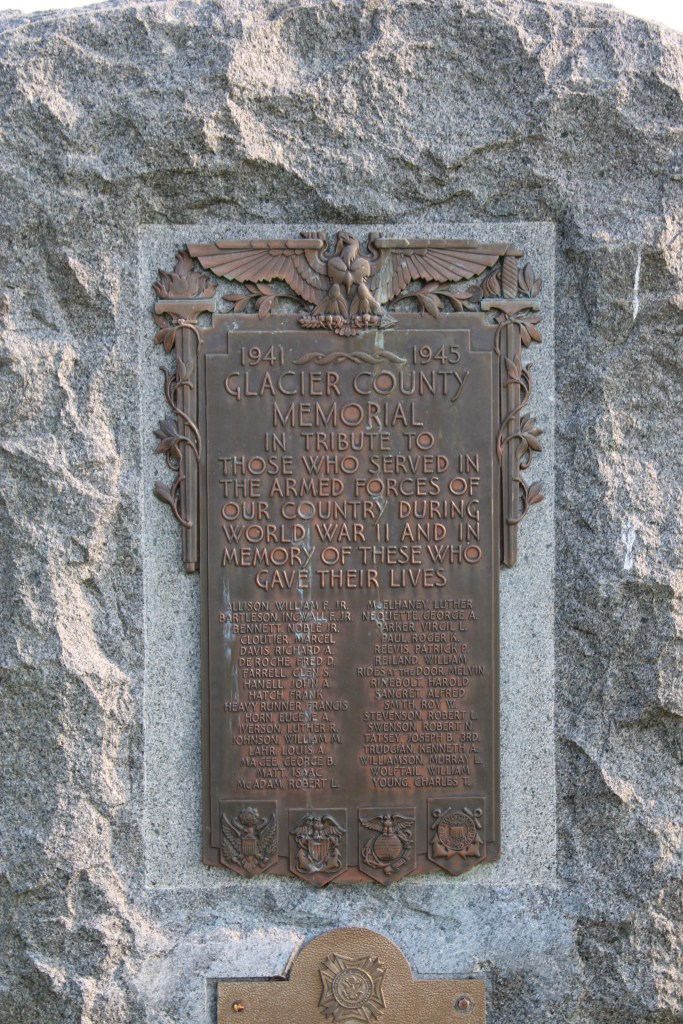
Another important marker is the veterans memorial from World War II. Cut Bank played a significant role as a satellite air field for the Great Falls Army Air Base. In 1942-43 pilots trained here in flying the B-17 Flying Fortresses. In 1948 the army conveyed the base to the town for civilian use.
Perhaps an unattended consequence of the military air base is that winter temperatures at Cut Bank was regularly available to national media, which played up the mage of Cut Bank as the coldest place in the lower 48 states. Cut Bank embraced the image, as this bit of roadside sculpture below attests. It stands at the eastern entrance into town on US Highway 2.
Crown Hill Cemetery is one of the oldest properties in Cut Bank open to the public. The cemetery is well maintained, well manicured and a testament to the respect and dignity local residents give to their past.
Standard histories tell you that Cut Bank, the seat of Glacier County, dates to 1891. But significant numbers of permanent settlers did not arrive until the first years of the 20th century, following a major investment by the Great Northern Railroad to build a huge steel bridge and railroad offices, shops, and a roundhouse. The Fort Benton River Press on February 12, 1901, reported that “Cut Bank is rapidly assuming a metropolitan appearance.”
The initial railroad boom soon slowed until the homesteader movement brought new growth. In 1911 town officials agreed to discuss the creation of a permanent town cemetery with state officials. Between 1911 and 1914 citizens formed the Crown Hill Cemetery Association and the first documented burials in the local newspaper took place in 1914.
Entrance to Crown Hill Cemetery
Located north of town the cemetery is on a slight rise and has an impressive view of Cut Bank to the South. A small lake is the focus of the cemetery plan.
See the grain elevators to the south.
Otherwise the cemetery contains long rows in a rectangular manner and there are few huge grave markers, instead many dignified and subtly designed markers cover the grounds.
There are several interesting markers and many note a fraternal lodge association.
The Thomas marker is one of the oldest.1936 marker with Art Deco styling
The Halvorson marker dates to be death of Mrs. Harry Halvorson who died in 1924. At that time her funeral was the largest ever held in Cut Bank. The Midland Empire of April 22, 1924 reported that 650 attended the funeral and that 77 cars went from the town Masonic Hall to the cemetery. A member of the Rebekah lodges in both Cut Bank and Shelby, Halvorson’s funeral attracted other lodge members from Shelby, Conrad, Valier and Browning. Her husband was the senior member of the Halvorson mercantile company, which started in 1901.
Another important marker is the veterans memorial from World War II. Cut Bank played a significant role as a satellite air field for the Great Falls Army Air Base. In 1942-43 pilots trained here in flying the B-17 Flying Fortresses. In 1948 the army conveyed the base to the town for civilian use.
Perhaps an unattended consequence of the military air base is that winter temperatures at Cut Bank was regularly available to national media, which played up the mage of Cut Bank as the coldest place in the lower 48 states. Cut Bank embraced the image, as this bit of roadside sculpture below attests. It stands at the eastern entrance into town on US Highway 2.
Crown Hill Cemetery is one of the oldest properties in Cut Bank open to the public. The cemetery is well maintained, well manicured and a testament to the respect and dignity local residents give to their past.
In my 1984 field study for the Montana state historic preservation plan, there were many places that were “known” to Native American tribal historians, students of the Lewis and Clark expedition, and scholars of the northern plains fur trade. But few of these places were provided public interpretation. much less public access. Such was the case with the Lewis and Clark campsite of early June 1805 at the confluence of the Missouri and Marias River.
Location of Lewis and Clark Expedition campsite
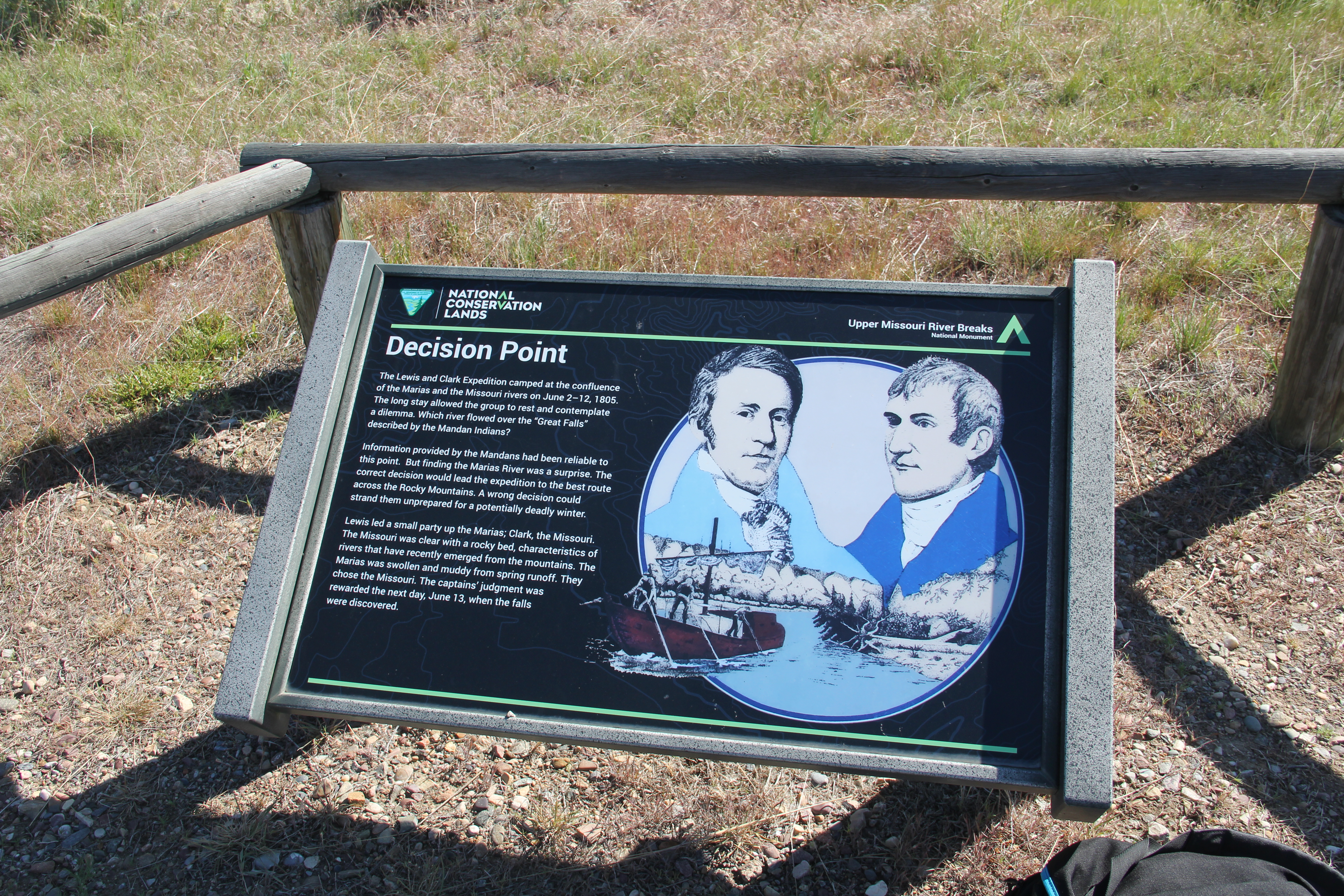
The campsite became known as decision point because as the expedition rested and regrouped there, they also decided which river to follow. After initial investigations, the members chose correctly and soon found themselves at the great falls of the Missouri River.
When I carried out my 1984 work, everyone knew that the confluence was at Loma, seen in the background of the photograph above. But access to the actual location and significant public interpretation was still to come. As I have written in numerous prior posts, one of the most significant changes from 1984-1985 and my recent work in Montana from 2012 to 2021 is the amount and quality of public interpretation and public access to significant historical landscapes. There has been a huge improvement, and Decision Point is an excellent example of federal agencies working with landowners and state and local government as part of the Upper Missouri River Breaks project.
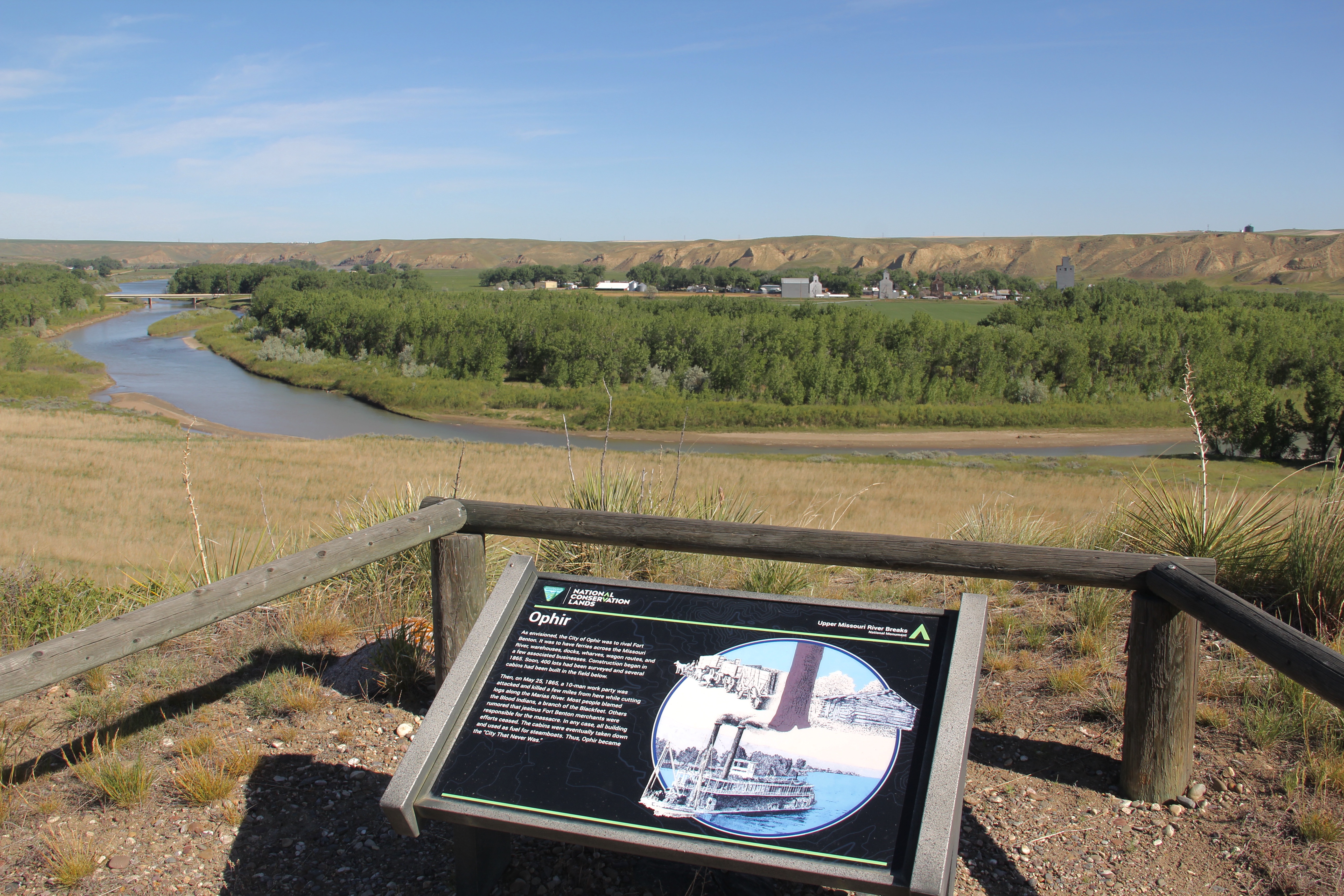
The image above tells the story of the steamboat Ophir and the amount of river trade that once marked the Missouri River. The interpretive marker below tells the story of the early American Fur Company trading post known as Fort Piegan.
Fort Piegan site
Even if you are not into the history of the region, the overlook created and maintained by the Upper Missouri River Breaks National Monument is a beautiful vista, and conveys strongly the landscape as encountered by generations of Native Americans and then in much more rapid succession by the Lewis and Clark expedition, American and Canadian fur traders, steamboat travelers, and by the 1880s the tracks of the Great Northern Railroad. An absolutely stunning historic site.
Grain elevators not only record the industrialization of plains agriculture; they also show you places–where the railroad left a siding and some sort of town, mostly gone now, took root over 100 years ago. Kevin is in northern Toole County, maybe 20 minutes south of the Canadian border. This lone elevator documents its homesteading era, that with the bust of the 1920s gave way to a boom in oil production in the middle decades of the 20th century. several oil tanks still remain from that era.
Kevin, Toole County, Montana
Kevin is the outlier–the rural grain elevators of Toole County record places that were once large agricultural communities, and have not been in population decline for decades. But elevators, both from the early days and from more modern times, remain as the sentinels of Toole County.
At Devon, Toole County, the elevators face U.S. Highway 2 and the tracks of the Great Northern Railway, now the Burlington Northern Santa Fe railroad. I wonder if you can see them from the Sweet Grass Hills. some 30 miles to the north.More recent metal grain silos surround the older grain elevator at Dunkirk, a land-locked place surrounded by grain fields for as far as the eyes can see. Galata, on the eastern end of Toole County, captures the fundamental nature of the Hi-Line landscape–bands of steel on raised roadbeds, dotted here and there by tall grain elevators and the spare building or two.
Milk River Irrigation Project Ditch at Dodson, Phillips County
In today’s New York Times (June 15, 2020), Montana Jim Robbins reported on the looming disaster facing Montana’s northern states if the St. Mary’s canal, which recently collapsed, is not repaired. The informative, insightful story focuses on the beginnings of the U.S. Bureau of Reclamation’s Milk River Irrigation Project, its pathway through southern Alberta, and its emergence in central Montana’s Hill County. It included several wonderful images of Havre, the seat of Hill County, and discussed the wide-ranging disaster faced by ranchers and small towns along the Hi-Line if the ditch did not get its long overdue repairs–to the tune of $200 million.
The Great Northern, the Milk River Project, and original U.S. 2 at Tampico
Robbins’ story immediately took my mind back to my travels throughout the Milk River Valley, from Hill County to Valley County, in 2013. The story of how modern transportation and engineering combined to transform the northern plains is so fundamental to the region’s history, yet it remains a story seldom told (another reason Robbins’ New York Times story matters). The image above represents the forces that led to the settlement and development of the Milk River Valley. Taken outside of the village of Tampico in Valley County, it centers the ditch between the two transportation systems–the Great Northern Railway on the left and the original route of U.S. Highway 2 on the right– that served the settlers drawn by the water. The image below shows the village of Tampico from the perspective of the ditch–the place would not exist without the ditch.
One of the very few historical markers in Montana that touches on the state’s irrigation history focuses about a historic bridge that once stood nearby at Tampico.
Large man-made lakes capture water to reserve it for use throughout the growing season. The images above are of Fresno Reservoir, on a rainy morning, in Hill County. While the two images below are of Nelson Reservoir, on a typically bright sunny day, many miles downstream in Phillips County.
The Milk River Project shapes so much of the Hi-Line, it has become just part of the scenery. I wonder how many travelers along U.S. Highway 2 in Phillips County even notice or consider the constant presence of the ditch along their route.
Not only are their scattered small towns along the Milk River Project, early agricultural institutions are often centered on the project. A great example is the Phillips County Fairgrounds, outside of Dodson, and the question may be well posed–why there? Dodson
is a tiny place, almost 20 miles from the county seat of Malta. But at the time of the Milk River Project, Dodson was vital; the ditch neatly divided the town into two halves, and a major diversion dam was just west of town. Here was a perfect place, at the turn of the century, for a fairgrounds. And it is a gorgeous historic fairgrounds.
My first encounter with the Milk River Project and the beautiful valley it serves came in February 1984 when Eleanor Clack took me on a tour of the bison kill historic site just west of downtown Havre. It remains an excellent place to see how the waters of the Milk have nurtured countless generations of peoples who called this place home.
Just last week I posted about two other Milk River Project towns–Lohman and Zurich–in Blaine County. My next post will continue this second look at the Milk River Project as I revisit Chinook, the Blaine County seat, where the ditch once again is almost everywhere, but rarely given a second thought.