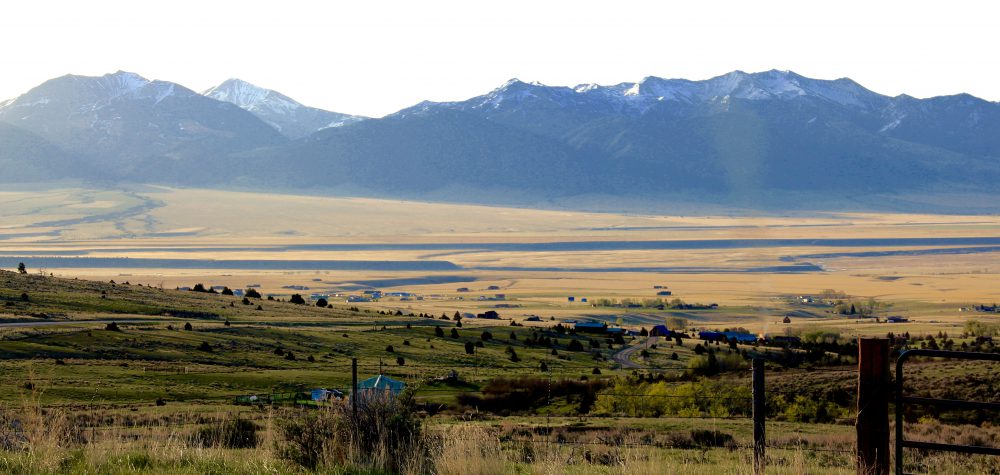


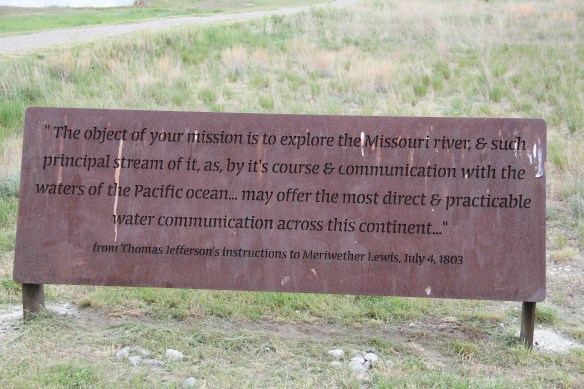
The Missouri River headwaters, located just north of the town of Three Forks, is one of the most important places in all of the United States. Here, within the boundaries of a state park that has improved its public interpretation significantly in the last 30 years, was one of the primary goals that President Thomas Jefferson gave the Lewis and Clark expedition in 1803–to find the headwaters of the Missouri River. When the expedition
traversed this land in 1805, they followed the footsteps of Bannock, Shoshoni, and Flathead Indians who had found this place and hunted the abundant game along the rivers long before the “explorers” arrived. Nevertheless, it was the Corps of Discovery that named the place. They found three sources–that they named the Jefferson, the Madison, and the Gallatin after the president and two of his cabinet officers–creating the Missouri River.

While fur trappers such as John Colter, who was an expedition member, soon returned to this site, and in the 1860s the settlement of Gallatin City was established, but only the


historic log Gallatin City Hotel of 1868 remains to mark a place where early Montana settlers thought an important town along the rivers would develop.


Recreational and interpretive features are now much more plentiful than 30 years ago but the park still exudes that feeling of openness and wildness that attracted that only the


Native Americans but later waves of 19th century trappers and settlers. It is a very special place within Montana and certainly earns its National Historic Landmark designation many times over.
 As you leave the Missouri Headwaters State Park access road (Montana 286) and return south to old U.S. Highway 10, you encounter a plaintive sign hoping to attract the thousands of heritage tourists who come to the state park–go a bit farther south and west and find the town of Three Forks.
 The story of Three Forks, on the western edge of Gallatin County, is not of rivers but of railroads, of how both the Northern Pacific and the Milwaukee Road corridors shaped this part of the state at the end of the first decade of the 20th century.

The Milwaukee Road came first, with Milwaukee Land Company agent John Q. Adams establishing the townsite in 1908, and later contributing its first landmark building, the two-story Colonial Revival-styled Sacajawea Hotel in 1910. Adams began the hotel in true Montana vernacular fashion, having contractors tack together existing moved buildings


into some type of lodging for railroad workers. Bozeman architect Fred Willson finished the building with a new facade along with various additions, leaving housing for railroad employees along with providing services for travelers. Heritage tourists were part of that mix, especially once the Montana Daughters of the American Revolution in 1914 placed a large boulder with a bronze plaque in honor of Sacajawea across the street from the hotel. Here was one of the state’s early examples of public interpretation of the Sacajawea story. In 2005, as part of the bicentennial of the Lewis and Clark Expedition, the Three Forks Area Historical Society commissioned artist Mary Michael to add a stylized statue of Sacajawea and her baby Pomp, turning the spot into a 21st century memorial to the Shoshoni woman.


Thirty years ago, the hotel was a renovation project we all at the Montana Historical Society wanted to happen. Listed in the National Register of Historic Places in 1980, it was a proud relic of that railroad that had just closed but also of the early automobile age when travelers could stop here, spend the night, and then travel by car to Yellowstone National Park far to the south. I would stay here when working in the region, reveling in

Sacajawea Hotel, 1990
the feel, the look, the sounds of a historic railroad hotel. Unfortunately the restart only lasted about 20 years. The hotel closed in 2001, and looked to have a bleak future in the new century. From 2009-2010 new owners, however, took this historic hulk and have


polished back into a jewel, better suited for more upscale travelers than in the past. It is the center point of a renewal of Three Forks, and part of a minor population boom that has seen the town, which basically had a flat population of 1100 to 1200 from 1950 to 1990 reach a population of almost 2000 in 2015. More on Three Forks in the next post
 Located between the Gallatin River and Interstate I-90, Logan is a forgotten yet still historically significant railroad junction on the Northern Pacific Railroad. Established c.


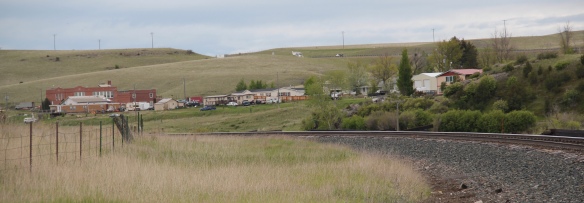


 Manhattan was not originally Manhattan, but named Moreland, as discussed in an earlier blog about the effort to build a barley empire in this part of Gallatin County at the turn of the century by the Manhattan Malting Company and its industrial works here and in Bozeman. But the existing railroad corridor, along with the surviving one- and two-


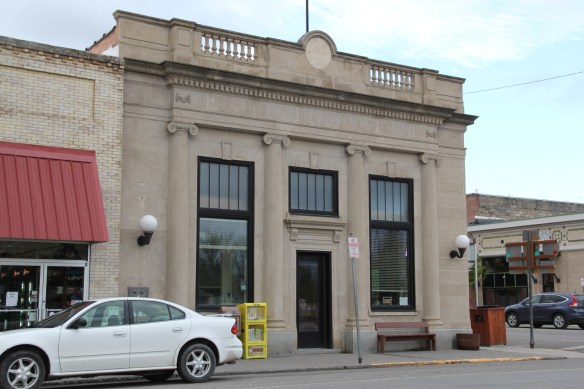
 The historic auto garage from c. 1920 above is one of the most significant landmarks left upon old U.S. 10, and I am glad it is still used for its original function in the 21st century.


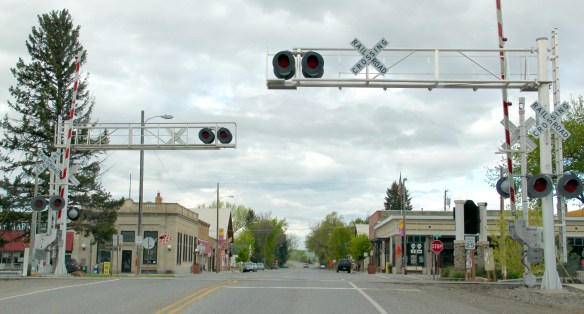 But it has many positives in place to keep its character yet change with the times. Many residents are using historic buildings for their businesses and trades. Others are clearly committed to the historic residential area–you can’t help but be impressed by the town’s well-kept historic homes and well-maintained yards and public areas.


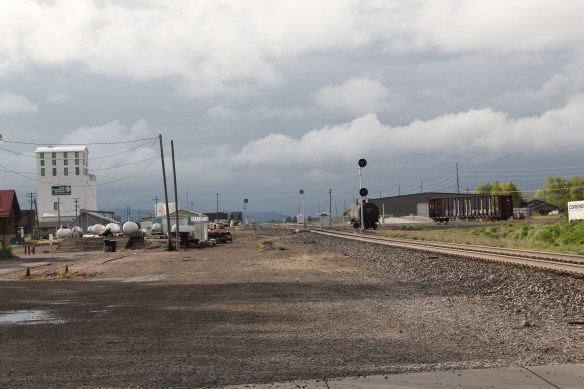 From 1983-85 Belgrade became one of my favorite Northern Pacific railroad towns. Often I would leave the interstate here, stop at truly one of the great small town bars/cafes along the town’s railroad corridors, and then travel on old U.S. 10 (the town’s Main Street) on to Manhattan, Logan, and Three Forks before popping up on US 287 and continuing to home in Helena.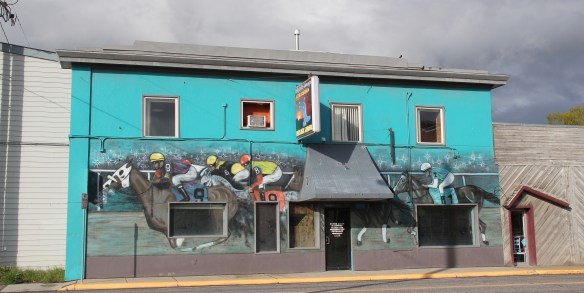

 Despite the boom, several landmarks remain. The Belgrade Community Church, built in 1904 as the town’s Presbyterian church, served in the 1980s as a joint church building for both the town’s Presbyterians and Baptists. This impressive Gothic Revival building had received several updates and additions in the mid-1970s. It became the Community Church in 1992 as the Presbyterians left and the American Baptist Church took over sole control of this historic church building.


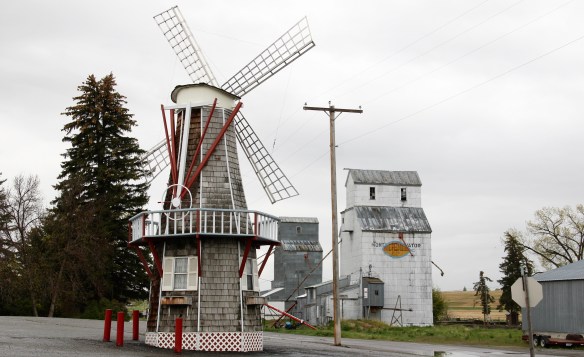 Montana history has many episodes that involve rich eastern and foreign capitalists who rolled the dice on Montana’s resources. Typically everyone thinks of the mining and railroad corporations of the late 19th century. But in several places across the Big Sky Country, investors looked to the land itself and dreamed of agricultural bonanzas.
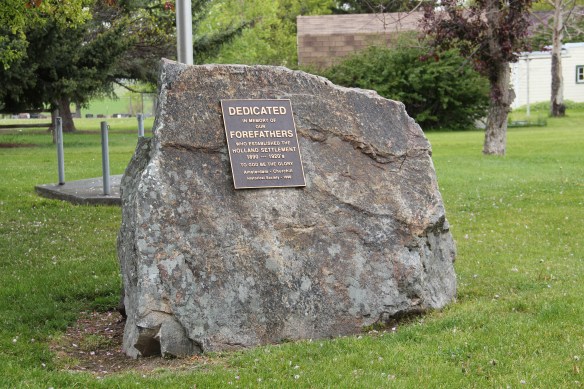
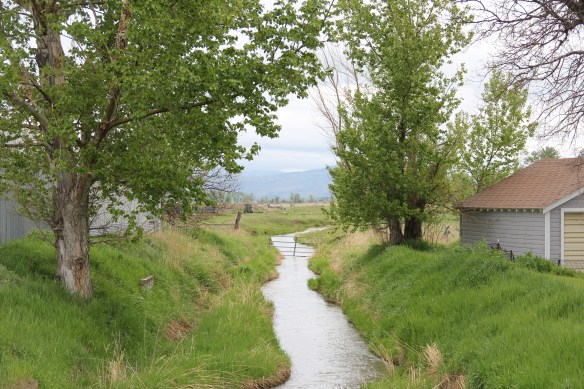 Such is the case of Amsterdam and Church Hill (now Churchill), two rural communities in today’s rapidly suburbanizing Gallatin County. The Manhattan Malting Company was mostly a New York City venture which in the early 1890s, before the terrible depression of 1893-1896, established an industrial base on the Northern Pacific Railroad, changing the name of the town from Moreland to Manhattan. The company purchased 13,000 acres,and acquired the best in agricultural technology, the Jacob Price Field Locomotive steam plow, to till the soil. They also convinced hundred of Dutch farmers to come to Gallatin County and work the land. Even with the hard times, or perhaps because of them, people still wanted good beer, and the company prospered. By 1905 the company decided to shed itself of the land and focus on malting barley.
 The new land company focused on getting farmers on its land, and to secure a railroad spur line. The railroad came in 1911, and the community name of Amsterdam reflected the ethnic origins of the surrounding farmers and ranchers. Even when the Malting Company failed during Prohibition, the farmers kept going, developing some of the still most productive farmland in the state.
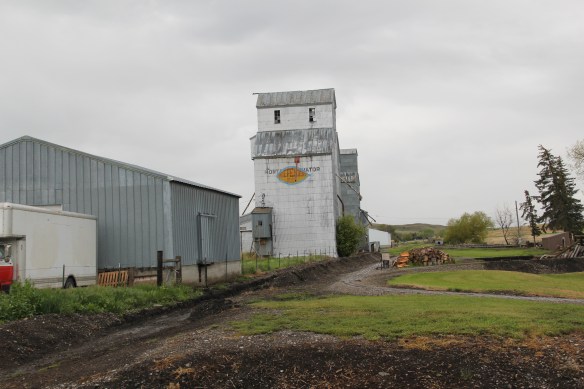 When I visited Amsterdam in 1984 the railroad line still operated but the spur closed the next year, leaving today only a faint corridor to mark its route. Look close and you can still see the outline of the T-plan town that was once “downtown Amsterdam” by the remaining historic commercial buildings, with the Danhof automobile dealership still in business today, with a newer showroom just east of the old railroad tracks.