
In 1982, two years before I began my survey of all 56 counties for the state historic preservation office, I took on a very meaningful and fun assignment—developing an interpretive tour of the recently restored Montana State Capitol. Jim Mc Donald’s firm in Missoula had developed a comprehensive study nd they and the many partners and contractors restored the grand spaces of this turn of the twentieth century building.
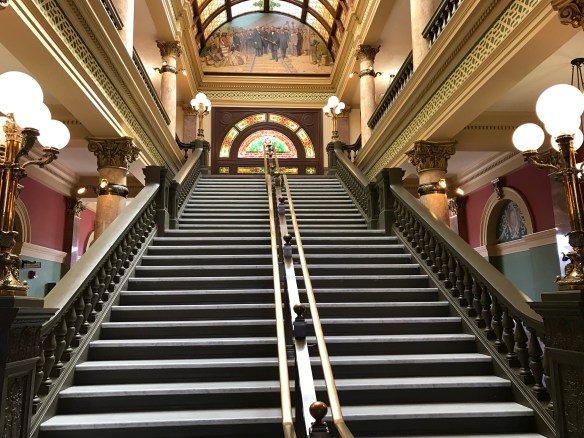


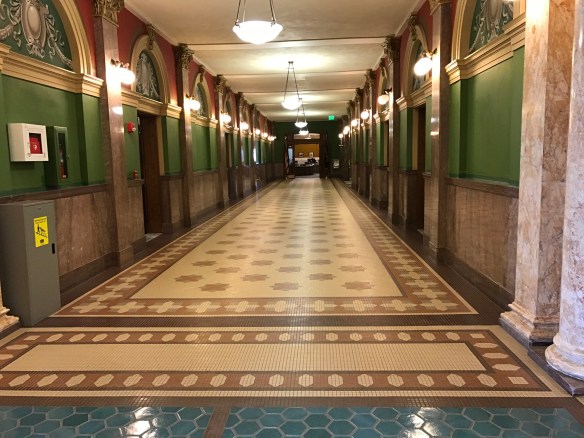
Designed by the firm of Bell and Kent, the Capitol is a jaw-dropping public space, which spoke of the state’s dreams and ambitions at its beginning. No matter how jaded you might be about politics and politicians today just a walk through the corridors of grandeur, and power, of the Capitol will remind you that democracy does matter and we the people continue down the demanding path of making ourselves rise up to democracy’s promise.
Plus the 1982 project was just a great learning experience. I worked most closely with Jennifer Jeffries Thompson, then the education curator at the Montana Historical Society, plus it became a way to meet and learn from the SHPO staff then, led by Marcella Sherry, and the architect Lon Johnson and architectural historian Pat Bick. Governor Ted Schwinden and his staff were great and I always appreciated the interest shown by Senate Republican leader (and future governor) Stan Stephens. Senator Stephens always wanted me to lead his groups through the building, but I never knew if that was because he thought I had something to say or that everyone always liked to hear me say it, with my southern accent echoing in the chambers and hallways.
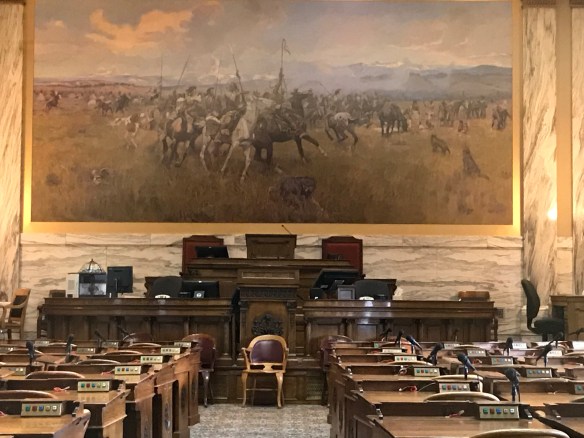
I learned so much because the Capitol was full of magnificent western art depicting pivitol moments in state history, as understood by state leaders one hundred years ago. Everyone (my celebrities included actors Clint Eastwood and Robert Duvall) wanted to see Charles M. Russell’s depiction of the Lewis and Clark expedition at Ross’s Hole in the House chamber. My favorites however were the series of historical paintings by Edgar Paxton in the legislative lounge and office area.


Paxson’s portrayal of Sacajawea showing the way at Three Forks—artistic license acknowledged—was always a favorite teaching opportunity for in a painting of 100 years ago Paxton depicted a reality—the presence and importance of a Native American woman and an African American slave, York—at a time when historians of the west had difficulty even acknowledging their existence in history.


I also liked the scope of Paxton’s narrative and the prominence of the Native American stor..u even to the surrender of Chief Joseph, which would have been fairly recent history when Paxton carried out his work.

The Senate Chamber taught other stories, from the process of voting and government to the story of the three Georgians who left the South in the midst of the Civil War to find riches in Last Chance Gulch, now Helena, and on to the massive Sioux and Cheyenne victory over George Armstrong Custer’s Calvary at the Battle of Little Big Horn.
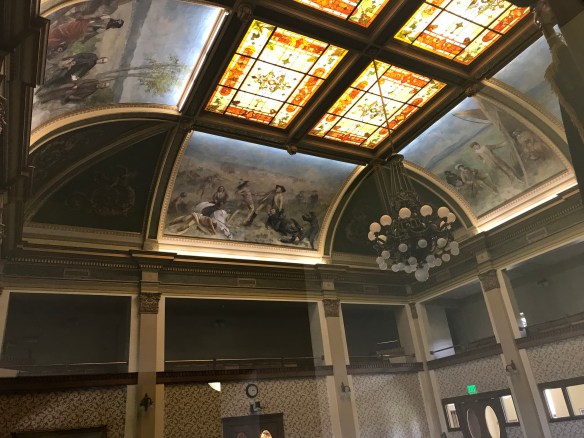
While I had stopped in at the Capitol several times in the last decade, I did not really explore. My trip this summer found many more history lessons throughout the building.


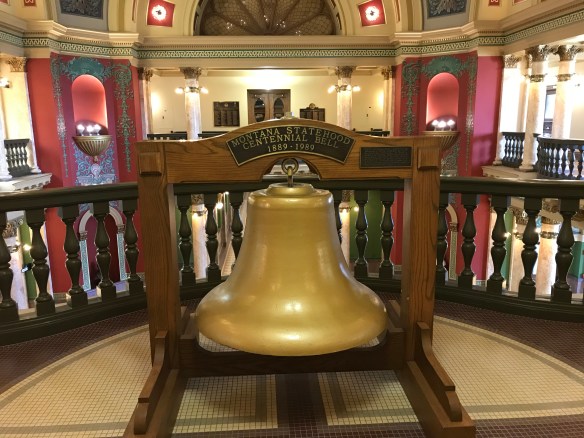
The statue of the Mansfields were an effective complement to the earlier statues for Wilbur F. Sanders and Jeanette Rankin, which had booth stood in the Capitol when I worked there in 1882 and 1983. I also really like the bronze bell added in honor of the state’s centennial. Both the Mansfields and the bell allow you to take visitors into Montana’s late twentieth century history.
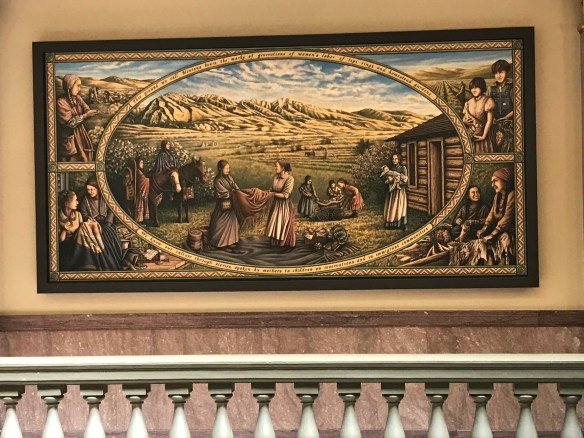
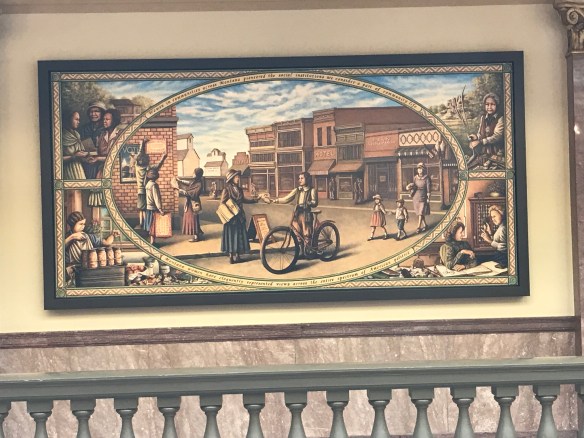
Then the women history murals, titled Women Build Montana, are just delightful, and inspiring. Installed in 2015 the murals by Hadley Ferguson add new layers of history and meaning to the grand old Capitol. Of course there is much more to the art and architecture of the State Capitol than what I have highlighted here. The Montana Historical Society maintains an excellent website that gives you all of the details you would ever need. But I hope that you do will visit the Capitol if you haven’t recently. Some 36 years after I first discovered its history, art, and architecture it still has many lessons to teach.
 The Montana State Capitol was my first heritage project in the state–the Montana Department of General Services worked with the Montana Historical Society to have me prepare an interpretive guide to the capitol, and then set up the interpretation program, following an excellent historic structures report prepared by the firm of Jim McDonald, a preservation architect based in Missoula.


 When I worked at the capitol, of course I passed daily by other state government buildings, and rarely gave those “modern” buildings another thought, except perhaps for the museum exhibits and archival collections at the Montana Historical Society. Years later, however, what seemed unbearably recent in the early 1980s were now clearly historic. One of my MTSU graduate assistants, Sarah Jane Murray, spent part of a summer last decade helping develop a inventory of the buildings and then, finally, in 2016 the Montana State Capitol Campus historic district was listed in the National Register of Historic Places.


 The Capitol Annex (1910) was the first building added to the capitol campus, and its restrained classicism came from the firm of Link and Haire.
 The nearby Livestock Building (1918) is like the annex, complimentary of the capitol’s classicism but also distinguished in its own Renaissance Revival skin. Link and Haire were the architects.
 The mammoth Sam W. Mitchell Building (1948-50) reflected the post-World War II interpretation of institutional modernism and its mammoth scale challenged the capitol itself, especially once a large addition was completed at the rear of the building in 1977. The architect was Vincent H. Walsh of Helena.
 Another Link and Haire building on the campus is the Board of Health Building (1919-1920), which continues the pattern of more restrained architectural embellishment that shaped the look of the government buildings in the middle decades of the century.
  The Cogswell Building (1954-55, 1981) is another Vincent H. Walsh design, again reflecting the stripped classicism institution style often found in Cold War era public buildings.
 While the capitol campus took form on a hill about a mile east of Last Chance Gulch, the state’s governor still lived downtown, in the Queen Anne-style “mansion” originally built by miner and entrepreneur William Chessman and designed by the St. Paul firm of Hodgson, Stem and Welter. The state acquired the house in 1913 to serve as the residence for the governor and his family, and it remained the governor’s “mansion” until 1959.
 It was the opportunity to be the curator of this house museum that attracted my newlywed wife Mary Hoffschwelle that led me to come with her to Montana. She was born in Billings; I had never been west of Dallas. But then over 25,000 miles of driving, visiting, and looking in Montana transformed me, and led not only to the 1986 book A Traveler’s Companion to Montana History but now this Montana historic landscape blog. Fate, perhaps. Luck–I will take it any day.

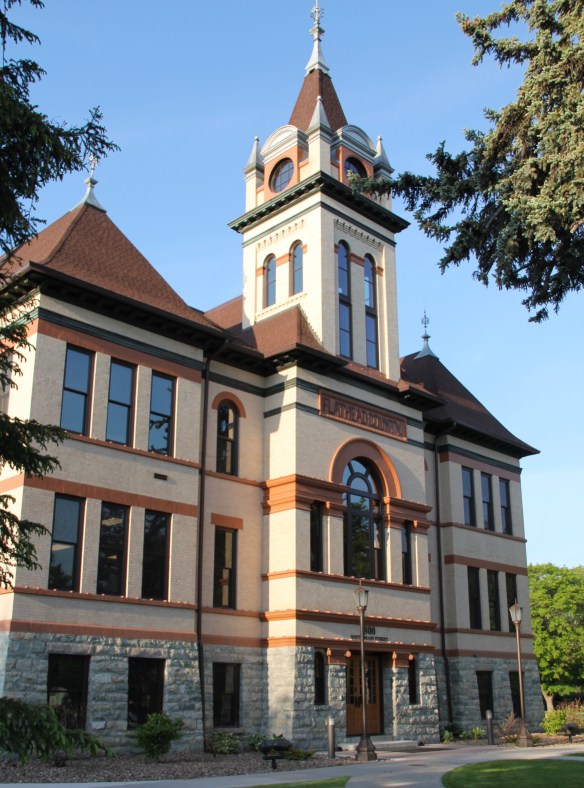


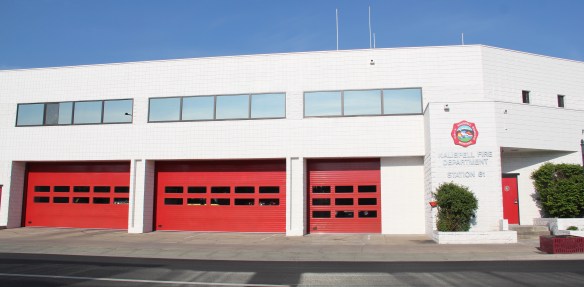 The town’s early religious institutions also built to stay, leaving key landmarks throughout the neighborhoods that serve as historic anchors today. On Main Street alone there is the unique Arts and Crafts styled First Presbyterian Church (1925-26) by architect Fred Brinkman, and the Gothic Revival masonry and tower of Bethlehem Lutheran Church (1932-1937).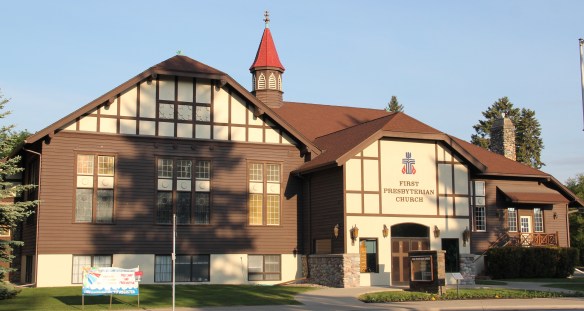


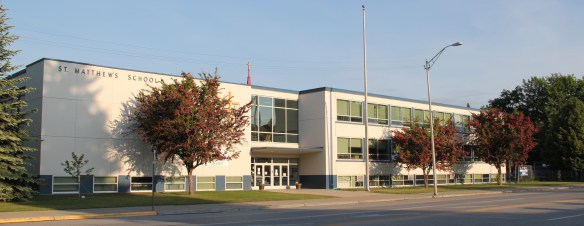
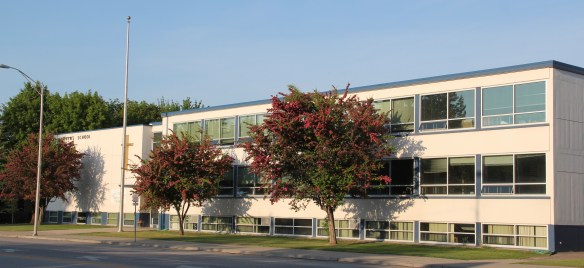 The city’s first Catholic school dated to 1917. The historic St. Matthew’s Catholic Church (1910) by Great Falls architect George Shanley remains the city’s most commanding Gothic landmark.


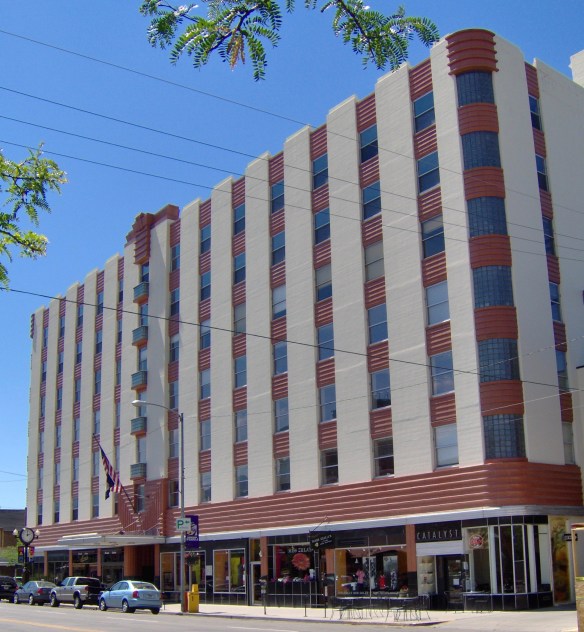 Downtown Missoula’s architectural wonders make it a distinctive urban Western place. Let’s start with my favorite, the striking Art Moderne styled Florence Hotel (1941) designed by architect G.A. Pehrson. Located between the two railroad depots on Higgins Street, the hotel served tourists and residents as a symbol of the town’s classy arrival on the scene–it was the first place with air-conditioning–of a region transforming in the 1940s and 1950s.
 With the coming of the interstate highway in the 1970s, tourist traffic declined along Higgins Street and the Florence Hotel was turned into offices and shops, a function that it still serves today.
 Next door is another urban marvel, the Wilma Theatre, which dates to 1921 and like the Florence it is listed in the National Register of Historic Places. The building was the city’s first great entertainment landmark (even had an indoor swimming pool at one time) but with offices and other business included in this building that anchored the corner where Higgins Street met the Clark’s Fork River. Architects Ole Bakke and H. E. Kirkemo designed the theatre in the fashionable Renaissance Revival style, with a hint towards the “tall buildings” form popularized by architect Louis Sullivan, the building later received an Art Deco update, especially with the use of glass block in the ticket booth and the thin layer of marble highlighting the entrance.


 Missoula’s first major department store and entrepreneurial center. The late Victorian era architectural styling of the two-story building also set a standard for many other downtown businesses from 1890 to 1920. These can be categorized as two-part commercial fronts, with the first floor serving as the primary commercial space and the second floor could be offices, dwelling space for the owner, or most common today storage space.


 Gibson, the building is one of the state’s best examples of what is called “Beaux Arts classicism,” a movement in the west so influenced by the late 1890s Minnesota State Capitol by architect Cass Gilbert.

 Just as impressive, but in a more Renaissance Revival style, is the Elks Lodge (1911), another building that documents the importance of the city’s working and middle class fraternal lodges in the early 20th century.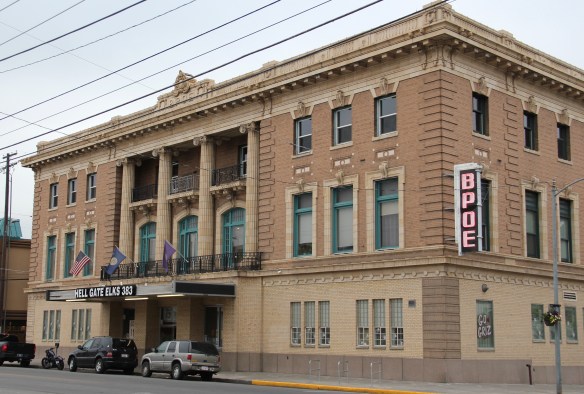
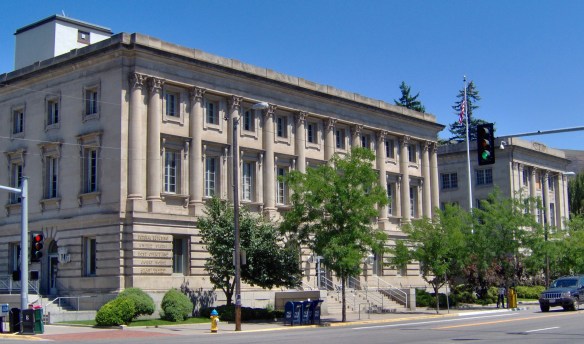


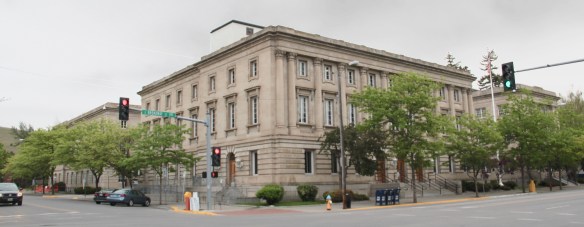 Of more recent construction is another federal courthouse, the modernist-styled Russell Smith Federal Courthouse, which was originally constructed as a bank. In 2012, another judicial chamber was installed on the third floor. Although far removed from the classic
 look, the Russell Smith Courthouse is not out-of-place in downtown Missoula. There are several other buildings reflecting different degrees of American modern design, from the Firestone building from the 1920s (almost forgotten today now that is overwhelmed by its neighbor the Interstate Bank Building) to the standardized designed of gas stations of
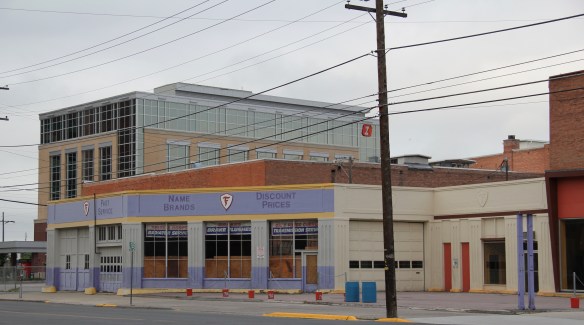 1930s and 1940s, complete with enamel panels and double garage bays, standing next to the Labor Temple.
 Modernism is alive and well in 21st century Missoula, with a office tower at St. Patrick’s Hospital, a new city parking garage, and the splashy Interstate Bank building, which overwhelms the scale of the adjacent Missoula Mercantile building–which had been THE place for commerce over 100 years earlier.


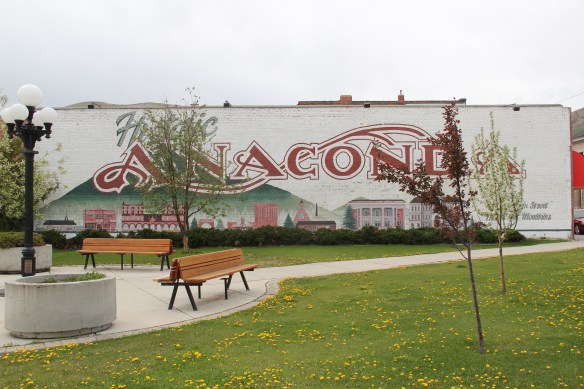 The public landscape of Anaconda has already been touched on in this blog–places like Washoe Park, the cemeteries, or Mitchell Stadium for instance. Now I want to go a bit deeper and look at public buildings, both government and education in this smelter city.
 Let’s begin with the only building in Anaconda that truly competes with the stack for visual dominance, the imposing classical revival-styled Deer Lodge County Courthouse. When copper baron Marcus Daly created Anaconda in the 1880s it may have been the industrial heart of Deer Lodge County but it was not the county seat. Daly was not concerned–his hopes centered on gaining the state capitol designation for his company town. When that did not happen, efforts returned to the county seat, which came to Anaconda in 1896. The courthouse was then built from 1898-1900.

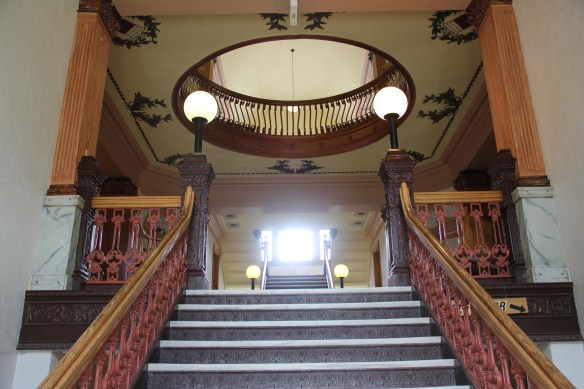
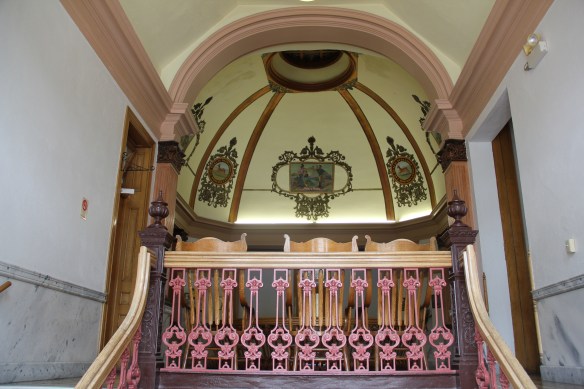
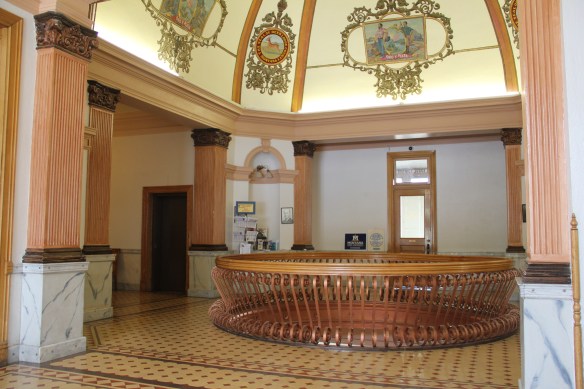
 in Montana is the lavish interior of the central lobby and then the upper story dome. The decorative upper dome frescoes come from a Milwaukee firm, Consolidated Artists. Newspaper accounts in 1900 recorded that the completed courthouse cost $100,000.
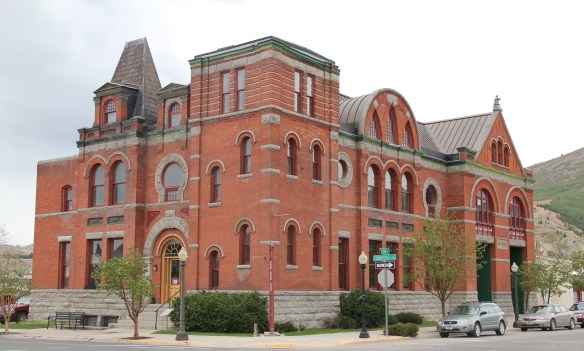 The bombastic classicism of the courthouse was at odds with the earlier more High Victorian style of City Hall, built 1895-1896, and attributed to J. H. Bartlett and Charles Lane. But classicism in the first third of the 20th century ruled in Anaconda’s public architecture, witness the Ionic colonnade of the 1931-1933 U.S. Post Office, from the office of Oscar Wenderoth.
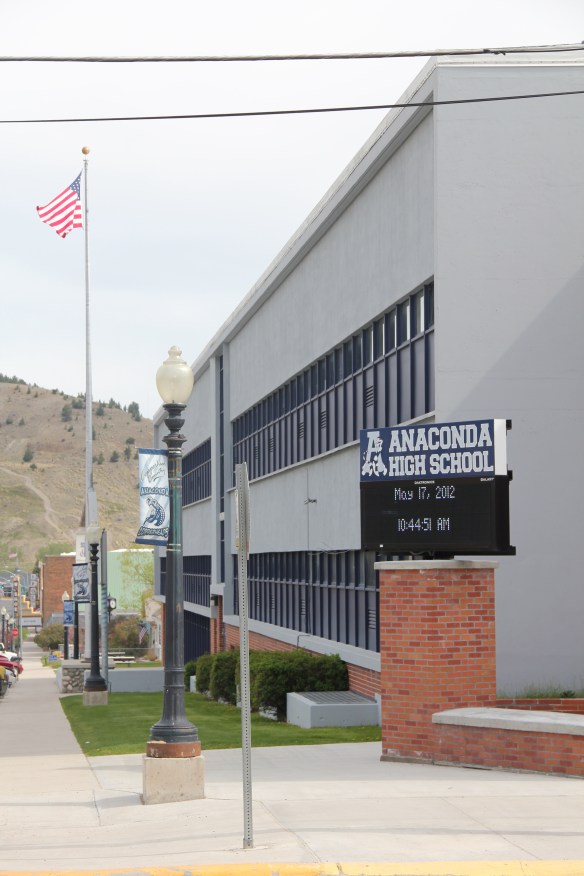
 Once Anaconda, bursting at the seams following the boom of World War II, chose to upgrade its public schools, it took a decided turn away from traditional European influenced styles and embraced modernism, as defined in Montana during the 1950s.
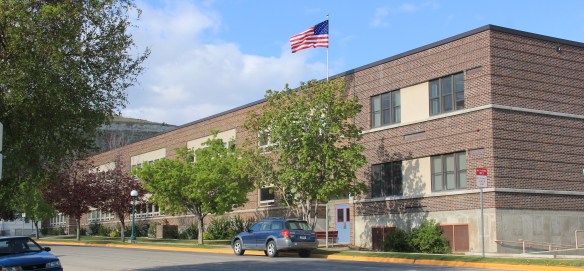 The long, lean facade of Lincoln Elementary School (1950) began the trend. Its alternating bands of brick punctuated by bands of glass windows was a classic adaptation of International style in a regional setting. The modernist bent continued in 1950-1952 with the Anaconda Central High School, the private Catholic school, now known as the Fred Moody middle school, only a few blocks away. Except here the modernist style is softened by the use of local stone, giving it a rustic feel more in keeping with mid-20th century sensibilities and the Catholic diocese’s deliberate turn to modern style for its church buildings of the 1950s and 1960s (see my earlier post on College of Great Falls).







 Montana's Historic Landscapes