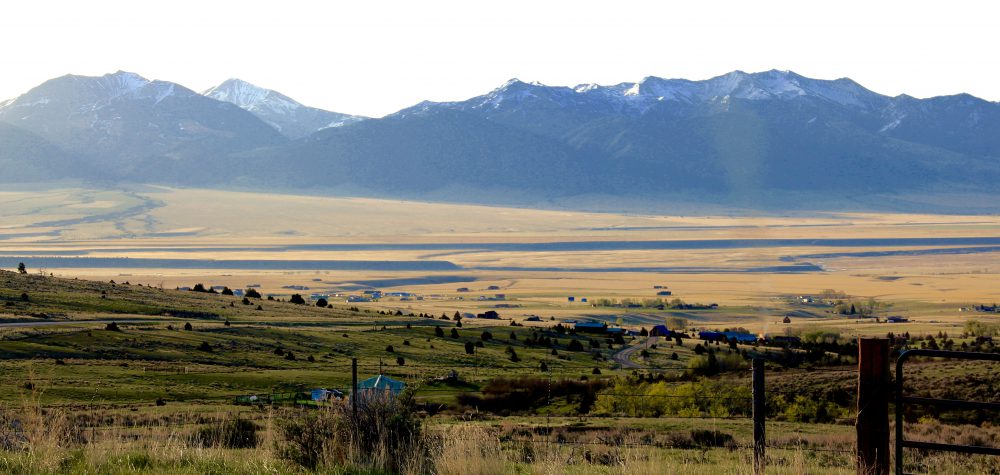
 Plains is the second largest town in Sanders County, noted as the home of the county fairgrounds, the center of the local agricultural economy, and like Thompson Falls a significant place along the Clark’s Fork River and the Montana Highway 200 corridor.

While the population was largely the same in 2015 compared to my last visit 30 years earlier, things had changed, such as the town’s elevator now served as the Grainry Gallery–an imaginative local adaptive reuse. New churches, new homes, and new businesses had been established. Yet Plains still retained its early 20th to mid-20th
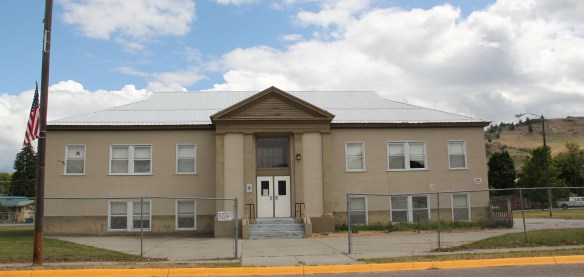
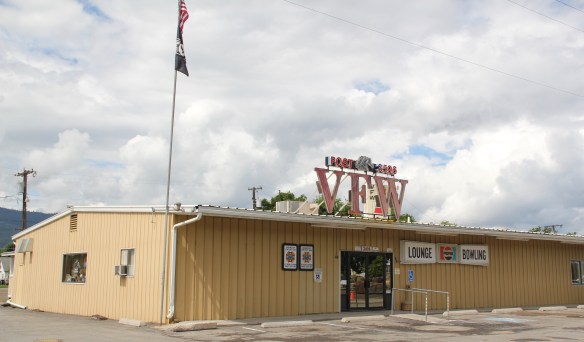
 century feel, be it in institutions, such as the local Grange above, or the continuation of the local VFW hall and bowling alley, below.
Among the biggest changes to this historic preservationist is the lost of the town’s historic high school from the first decade of the 20th century. In a small park along Montana Highway 200, the cornerstone arch from the school was saved and now is a


monument to that educational landmark. Adjacent is the log “Wild Horse Plains” school, which has been moved to this spot and restored during the American Bicentennial. According to local historians, the more appropriate name is “Horse Plains,” since the Salish Indians once wintered their horses here but the name “Wild Horse Plains” is the one that has stuck here in the 21st century.


The Wild Horse Plains Women’s Club uses the old school for their meetings and keeps up the property and its landscaping. Indeed, one thing you like about Plains–a railroad town from the turn of the 20th century–is its sense of pride, conveyed by places like the school park or in the stewardship shown to local historic homes.

This same pride in place is also conveyed in our last Sanders County stop, the very different history of Noxon, near the Idaho border on Montana Highway 200. The Noxon Bridge was among my favorite northwest Montana modern landmarks–but in 1984 I thought little more about it because few things in Noxon were built before 1959-60.


That was when the Noxon Hydroelectric Dam went in operation, transforming this part of the Clark’s Fork River into an engineered landscape shaped by the dam, power lines, and the reservoir.
 The Noxon Dam was finished in 1959. It is a mile in length, 260 feet in height and 700 feet wide at its base. Its generators can power approximately 365,000 homes, making it the second-largest capacity hydroelectric facility in Montana.
 Today visitors can view the dam from various parking areas and short walking trails, one of which passes over the historic line of the Northern Pacific Railroad. The property has interpretive signs about the history of the project as well as about the engineering of hydroelectric power.
 Along the banks of the river/reservoir, a much more recent public park has opened–with public sculpture reminding everyone of the Native Americans who once camped along the
 river at this place. By bringing the deep past of the region in view of the modern, this site is a new favorite place–wherever you are in Montana, and there are many modern engineering marvels–the Indians were always there first, using those same natural resources in far different ways.

 for places to rest, relax, and enjoy the precious hours away from the workplace. So much has changed in Anaconda since the closing of the smelter in the early 1980s–but the town’s distinctive places for recreation and relaxation remain, a big part of the reason Anaconda is one of my favorite places in Montana.
 Let’s start with the magnificent Art Deco marvel of the Washoe Theater. Designed in 1930 by B. Marcus Priteca but not finished and opened until 1936, the theater has stayed in operation ever since. It is remarkably intact, especially when owners refused to follow the multi-screen craze of the 1970s and kept the lobby and massive screen


 A drink after the movie: still happens with regularity in Anaconda, due to the plethora of neighborhood bars, from the Anaconda Bar to the Thompson Bar. The range of sizes and styling speaks to the different experiences offered by these properties.


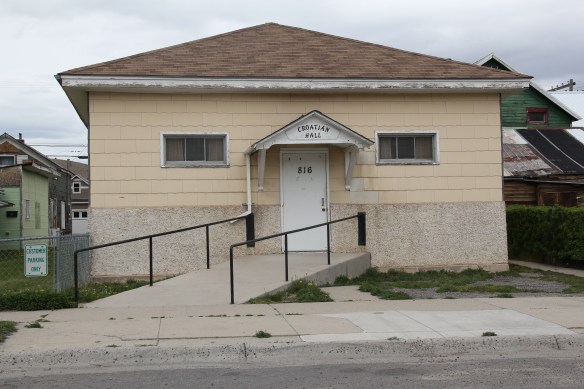 The Elks Club in the heart of downtown is a totally different statement, with its sleek 1960s modernist facade over an earlier turn of the century Victorian styled brick building reflecting a more prosperous and larger membership.

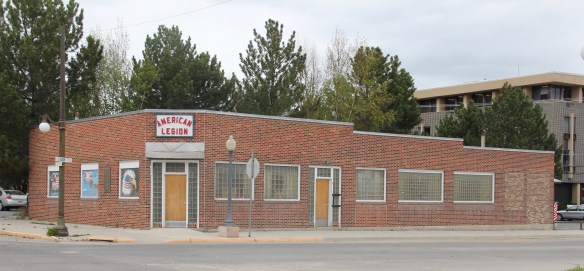 With its glass block entrances and windows, the American Legion lodge seems like another lounge, but the American Eagle mural says otherwise.

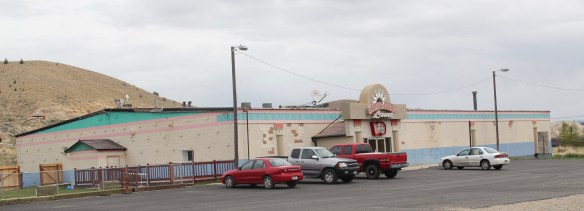 If not bowling, why not read a book. At least that was the motivation behind Progressive reformers and their initiative to create “free” (meaning no membership fees) public libraries at the turn of the 20th century. Anaconda has one of the state’s earliest and most architecturally distinctive libraries in the Hearst Free Library.

 Another Progressive-era institution is Washoe Park, established by the copper company and home to the first fish hatchery in the state. Washoe Park was a place for outdoor recreation, with ball fields, picnic areas, and amusement attractions. It also was home for the town’s baseball field and its historic grandstands and refreshment


 New renovations at the park have been underway, improving trails, the hatchery, and the outdoor experience plus adding public interpretation at appropriate places. The park is being re-energized but respect still shown its early elements, such as the historic Alexander Glover cabin, built c. 1865 and identified as the oldest residence in Anaconda, which was moved into the park as an interpretive site, early, c. 1920.
 Another outdoor recreational space that has been receiving renovation is the historic Mitchell Stadium complex, a New Deal project of the Works Progress Administration from 1938-1939. The stadium, designed to give the high school modern facilities for football and track and field, is quite the place, retaining so much of its original understated Art Deco styling.
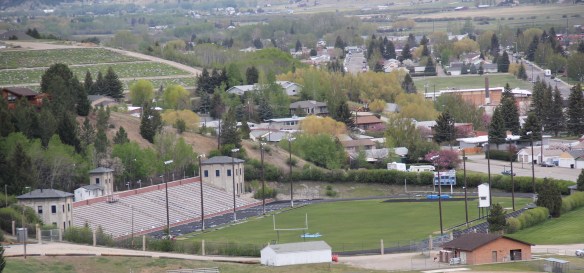 Unlike Washoe Park, here was a new public space, in keeping with the New Dealers’ faith in recreation and community, that was not a creation of the copper company for adult workers but for high school athletes.


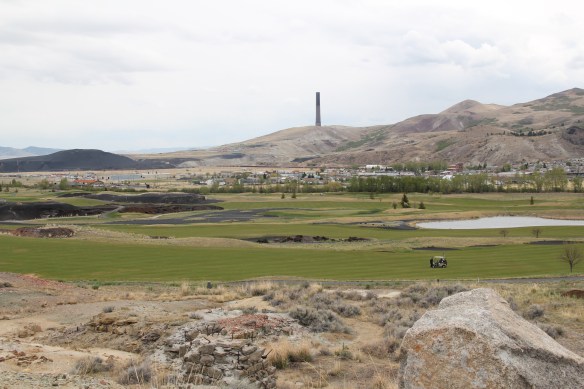 But even on the links of this innovative adaptive reuse project you cannot escape the overwhelming presence of the copper company stack, and mounds of devastation it left behind. Here is an appropriate view that sums up the company influence on the distinctive place of Anaconda.
 Montana's Historic Landscapes