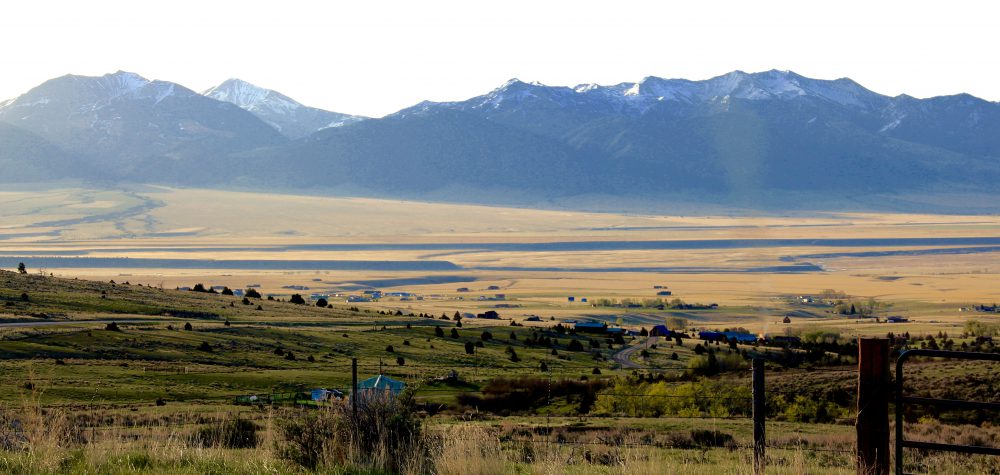
 In the preservation plan survey of 1984-1985 rarely did I give much attention to historic cemeteries–no one in the Helena office was focused on this property type and in all of my public meetings I never heard someone to make a case for cemeteries as either designed landscapes or community memory palaces. But in the thirty years since my work in the south has constantly drawn me to cemeteries, and when I began my re-survey of the Montana historic landscape in 2012 I was determined to look closely at cemeteries across the state.
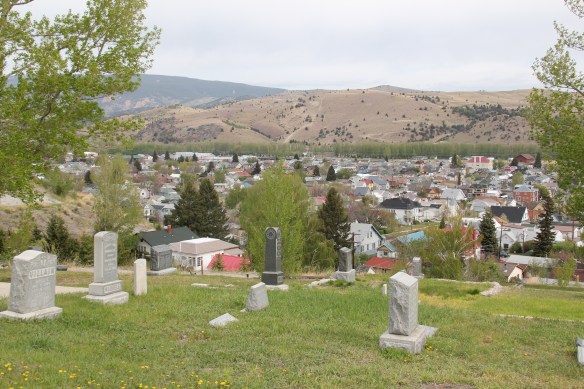
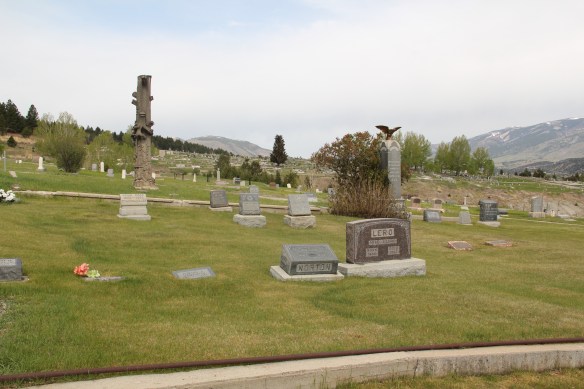 As i climbed the hill behind the courthouse and walked into Upper Hill Cemetery, I found acres of graves and monuments, a reflection of the town’s late 19th and early 20th century roots, and marker upon market that spoke to the ethnic groups, trade loyalties, and general working-class makeup of Anaconda. Here was a true artifact that I most certainly missed in 1984, and worthy of listing in the National Register of Historic Places.
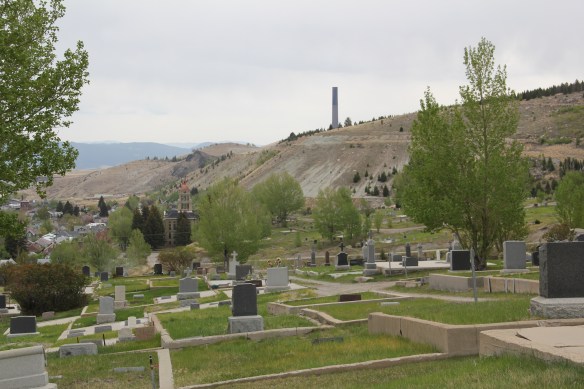
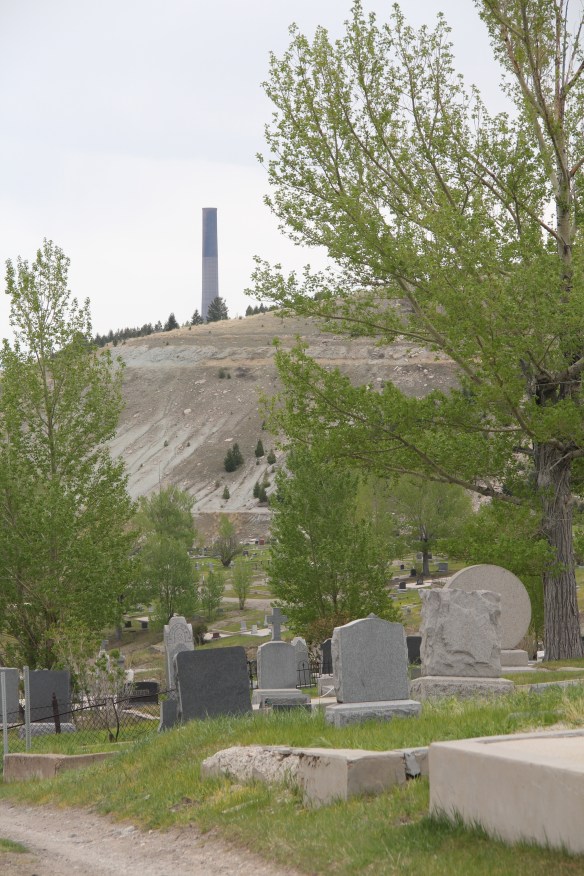 One unmistakable reality was that in death, as in life, Anaconda laborers could never leave the overwhelming presence of the Stack–wherever you go within the acres of the Upper Hill and Mt. Carmel Cemeteries you need leave the presence of the concrete and steel giant of the Anaconda Copper Company. Striking how many of the headstones face the stack.
 Another reality was that fraternal loyalties–the brotherhood of labor–remained even as the bones that had once labored so diligently had decayed into dust. Fraternal organization often offered burial insurance–you were guaranteed a place within the fraternal plot even if your own birth family–who might be on the other side of the ocean–had long ago forgotten your face.
 The Brotherhood of American Yeomen offered a gated plot, defined by a Victorian cast-iron fence that made a perfect rectangle.
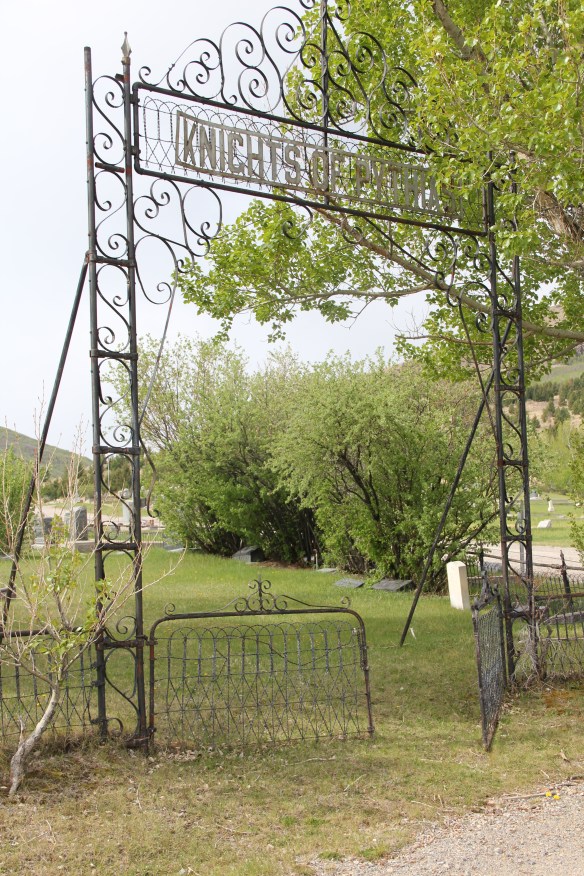
 The Knights of Pythias, on the other hand, offered a monumental cast-iron gate, emblazoned with their name, as the entrance to their fraternal plots.
The Eagles plot is identified by a large concrete column with an aggressive appearing metal American bald eagle spread across the top.


Some organizations, often forgotten today, left intricately carved memorials to their brothers. The T.O.T. E. is a secret password, purported to mean “totem of the eagle,” that belongs to the Improved Order of Red Men, the nation’s oldest fraternal organization that traces its roots to the Sons of Liberty and the Boston Tea Party of the American Revolution. Its monument in Upper Hill Cemetery is the most evocative of all.
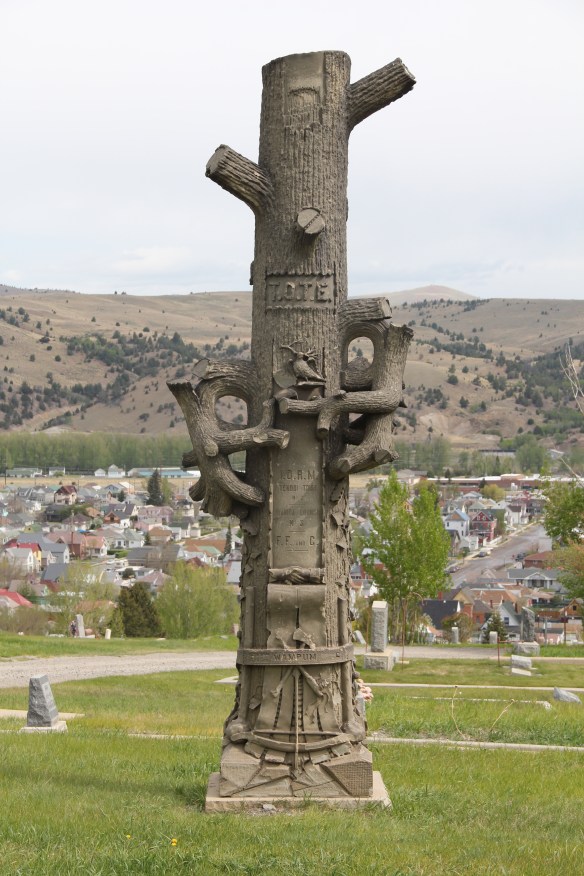
 Details and hidden meanings abound in this graveyard sculpture, and it is impossible to take it all in at once.


 Hayes Lavis, who died in the Great Depression, is one of the few of the Improved Order of Red Men identified in this fraternal grouping.
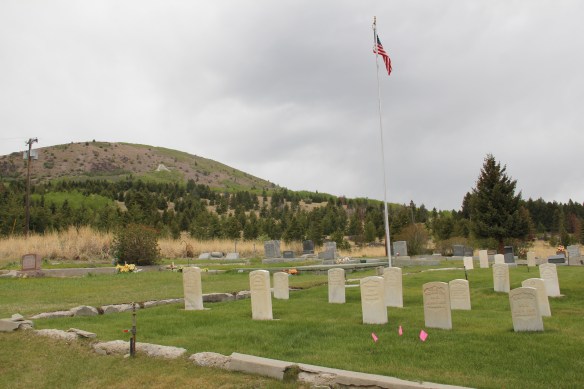 Military veterans are found throughout the cemetery–that is no surprise, but then it is surprising to see how many local men fought and died in the Spanish-American War of the late 1890s. The plot in their honor rests at one end of the cemetery, under the watchful gaze of the town “A” on the nearby hillside, but the low concrete wall that once defined the memorial is crumbling, just as our memory of this war and its veterans fade in the 21st century.


Other markers speak to the diverse ethnic communities that comprise Anaconda. My Carmel is the Catholic half of the huge cemetery.


The McGrath marker is one of the hollowed imitation stone but actually metal markers that were made elsewhere and shipped to Anaconda.
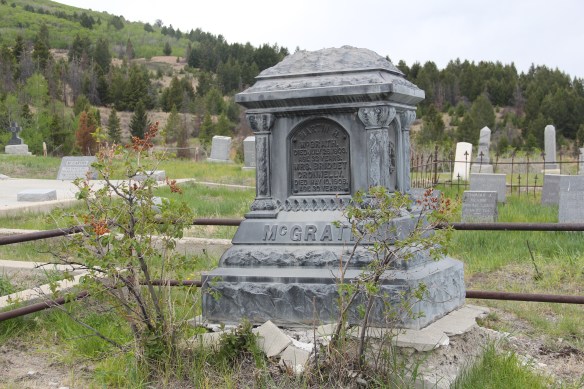 Family plots are also prevalent, with that of the Brown family and the loss of a child being particularly poignant.


The Thomas Michael monument also features statuary mourning the death of a child. Few places anywhere are sadder than the “children’s” section of this cemetery.


The huge cemeteries are certainly an interesting and significant historic property, one that should be listed along with the Stack as one of Anaconda’s attractions.


It looms over the entire city and leaves an unmistakable human face to the industrial and transportation history of Anaconda.
 Along the Missouri River is Paris Gibson Park, deep in the heart of Great Falls, Montana. Gibson was one of the classic civic capitalists of the late 19th century who understood that as the community prospered he too would achieve this dream of building a great western empire, with his town of Great Falls as the center. Almost 100 years after his death, in 2015, residents, preservationists, historians, and economic developers began discussions on establishing a heritage area, centered on Great Falls, but encompassing the Missouri River as the thread between the plains and mountains, that has shaped the region, and the nation, for hundreds of years. I strongly endorse the discussion and will spend the next several posts exploring key resources in Cascade County that could serve as the foundation for a larger regional story.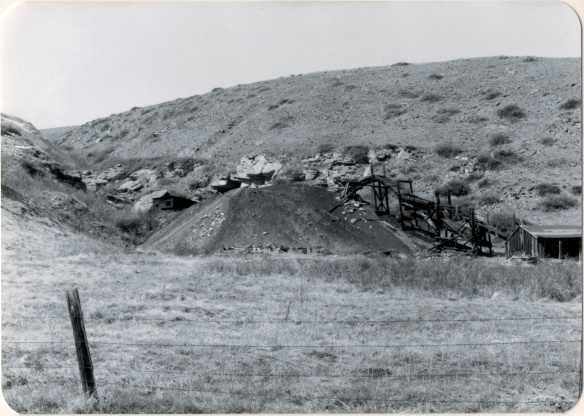
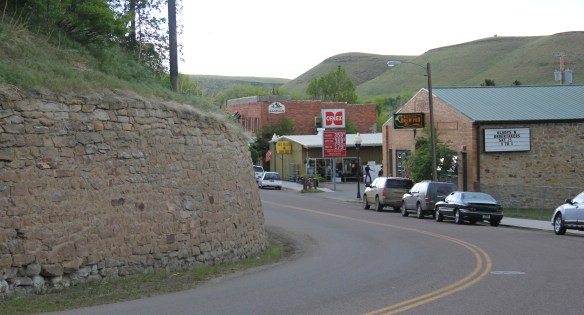
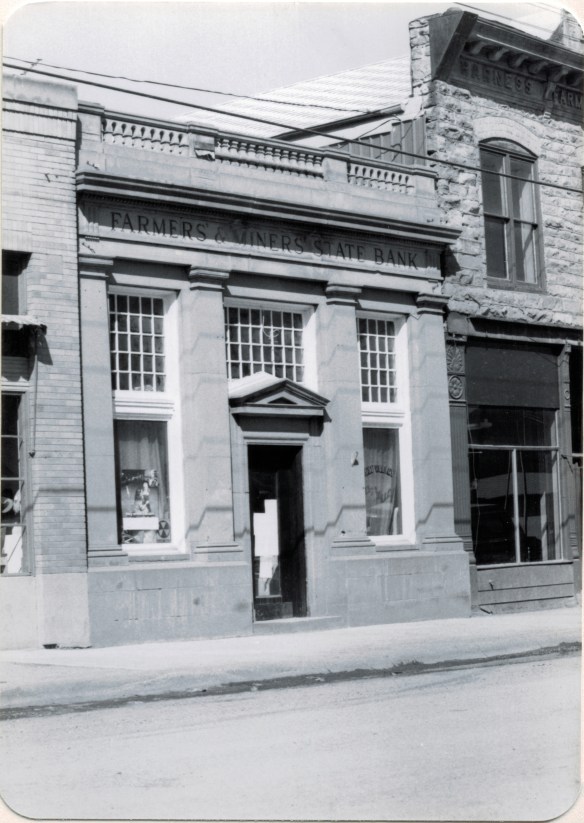
 Thirty years later, Belt’s population had bottomed out, declining to under 600 by the time of the 2010 census. But both times I have stopped by, in 2013 and 2015, the town has a sense of life about it, and hope. The town’s two historic taverns, the Harvest Moon Tavern and the Belt Creek Brew Pub, as well as the Black Diamond Bar and Supper Club attract visitors from nearby Great Falls and elsewhere, giving the place a sense of life at evenings and weekends.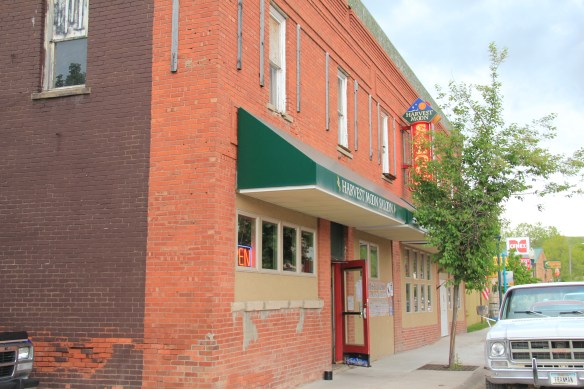
 When planners talk about heritage areas, they often focus on the contributions of local entrepreneurs who take historic buildings, like the Pioneer above, and breathe new life into them. Throughout small town Montana and urban commercial districts, new breweries and distilleries are creating such opportunities.
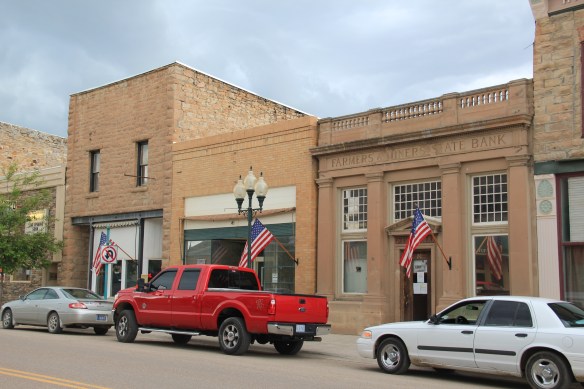
 Belt has a range of historic buildings, mostly of vernacular two-part commercial style that speak strongly to the boom of 1900 to 1920. The Victorian-styled cornice of the Belt Hardware Store (1896) speaks to the town’s origins. The Knights of Pythias Lodge of 1916 has been restored as a community theater, another reason for visitors to stop and explore.
 The result is a living cultural experience, since nothing in Belt is over-restored or phony feeling. It is still a gritty, no frills place. That feel is complemented by the Belt museum, which is housed in a historic jail on road down into town and within sight on a railroad trestle, a reminder of what literally drove the town’s development, coal for the railroads.
 During the 1984 survey, I gave the jail a good bit of attention since this stone building spoke to the craftsmanship of the era, the centrality of local government as the town developed, and the reality that this building was the only thing in Belt listed in the National Register of Historic Places. But in 2004 the state historic preservation office approved the Belt commercial historic district, and that designation has done much to drive the town’s recent revival. Belt is just the first place that speaks to the promise of the Great Falls heritage area concept.
 Montana's Historic Landscapes