My first stop in Montana will be Billings, the metropolis of eastern Montana. There new uses as a performance have made the Art Deco styled Babcock an important contributor to downtown life and business. In the 1980s most Hi-Line county seats had a movie house–have they survived the video, satellite, Internet onslaught? What about the transfer to digital technology for films? I will start to find out in less than 2 weeks.
Blog Archives
Bar Signs and Neon along U.S. 2
Image

Along the old main streets of the towns along U.S. 2 there is a wonderful array of historic store signs, many for restaurants and bars, others for stores or movie houses. These all speak to a time when U.S. 2 was a major east-west artery, long before interstate travel dominated auto and truck travel. In places like Shelby the row of signs can make the place look dated, but for heritage tourism travelers the signs beckon today as much as they did 60 years ago.
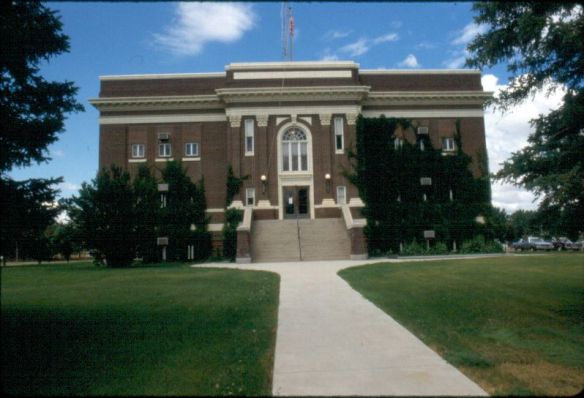
Phillips County Courthouse (1921), Malta
Image

This image comes from my last quick trek through part of northeast Montana in 1988. The unstated classical beauty of this courthouse in Malta impressed then, and I trust it will still be as well maintained and preserved 25 years later. I’m in Malta at the end of Memorial Day weekend. Compared to Tennessee, where I have now worked for 28 years, courthouses and their grounds often appear as afterthoughts in the Montana landscape. Whereas the central courthouse square plans of Tennessee are at the center of the historic commercial district, I was reminded in my 2012 work in southwest Montana that often the Montana courthouses are on the margins (like the Beaverhead County Courthouse in Dillon) or nestled within residential districts (like in Deer Lodge). In the railroad towns of the Hi-Line, the depots are at the head of town and serve as the entrance to the primary commercial district. This spatial difference speaks both to when Montana county seats were created and to the overwhelming influence of the railroads in the region one hundred years ago. It is one of the most interesting patterns in the Hi-Line’s historic landscape.
Sacred landscapes
Image
St Mary’s Catholic Church in Stevensville is one of the most famous early buildings in the northwest. These types of sacred landmarks I documented adequately in 1984, but churches overall and sacred landscapes (such as cemeteries) not so much. My thinking then was that these places were not threatened, therefore I could give them less attention. Wrong. Here is a case where my southern work informs the new Montana project. Churches and cemeteries are powerful symbols of faith and commitment and just as important as community markers. The sacred landscape will receive considerable attention this summer.
Grain Elevators at Loring, Phillips County, 1984
Image

Grain elevators and the Hi-Line–it seems that you cannot think of one without the other. If the Cottonwood church (previous post) was a human sentinel on the northern plains, the tall, stark, unadorned elevators are part of the corporate landmarks of the region. Here is where the intersection between the long hours of toil for Hi-Line farmers met the business reality of the railroad, and of the great grain wholesalers of the midwest. The elevators were early 20th century signs of progress; today they are often the only remaining markers of a town that has been long ago abandoned, hopes and dreams forgotten.
Cottonwood church, Hill County, in 1984
Image

The Hi-Line is populated with scattered buildings and places that speak of the high hopes, and broken dreams of the homesteading era. One of the most compelling places I found in 1984 was at Cottonwood. Here was an abandoned church, dedicated with a flourish in 1924 judging from a historic photo in the 1976 county history. In 1984 the building was like a sentinel, standing alone on the high plains, of what people thought they could accomplish in a demanding, stark landscape. Will this building still remain today?–I find out in late May when I will be working in Hill County.
Gamer’s Cafe, Butte
Image
The foodie revolution is impacting heritage tourism in a big way in Tennessee. In southwest Montana last spring I found, to my great pleasure, many heritage cafes and restaurants still humming along, such as this 1930s counter at Gamer’s in Butte. But no doubt there are many more national chains in the state than before. Finding the heritage businesses of the Hi-Line and seeing how they made it through the last 30 years will be one of the fun patterns to explore starting May 23.
Town Signs along U.S. Highway 2
Image

Another pattern I look forward to exploring along US Highway 2 this summer are the many town signs that greet you or lure you off the highway into the small towns along the corridor. The penguin at Cut Bank plays into the older tradition of the town being mentioned in national weather news as having the “low tonight is in Cut Bank, Montana” since its old air base there meant that its temperature got out into the larger news feeds of the wire services. It stands at the fork of old US 2, which passed through the heart of town between the courthouse and Great Northern depot, and a later “bypass” US 2. Few signs along the Hi-Line are so catchy as the Cut Bank penguin–but to the east in North Dakota and Minnesota are numerous giant signs–from buffalos to Paul Bunyon–so well discussed years ago by Karal Ann Marling.
Big Hole national battlefield
Image
On the Hi-Line fieldwork next month, another major theme will be Chief Joseph and the Nez Perce Trail, since the Bear’s Paw battlefield is in the region. Certainly the new visitor center and the outstanding Nez Perce-centered exhibit at Big Hole were unexpected surprises. You wish all battlefields were interpreted in such “whole story” ways. Last Memorial Day weekend it was cold and windy at Big Hole, an appropriate setting for such a somber and sad place.
Daniels County Courthouse, February 1984
Image

One of the major goals of my work is to document, and then interpret, change in the state’s built environment. Here is the Daniels County Courthouse in Scobey from 1984. It was then a false front frame building that met community needs but even then it seemed a relic of the early homesteading boom in northeast Montana. The new 21st century oil boom is reshaping this region, at some towns, rather quickly. What has happened to the courthouse, and to Scobey? I will know in a little over a month.


